Independent extender & router guidesHelping you find your connection.
The guide library

TL-SG105-M2 vs NETGEAR MS105: a practical five-port 2.5G switch checklist

Explore the guide library · Switch selection and setup

These unmanaged switches serve a similar role; choose from connection needs, placement, support and local availability.
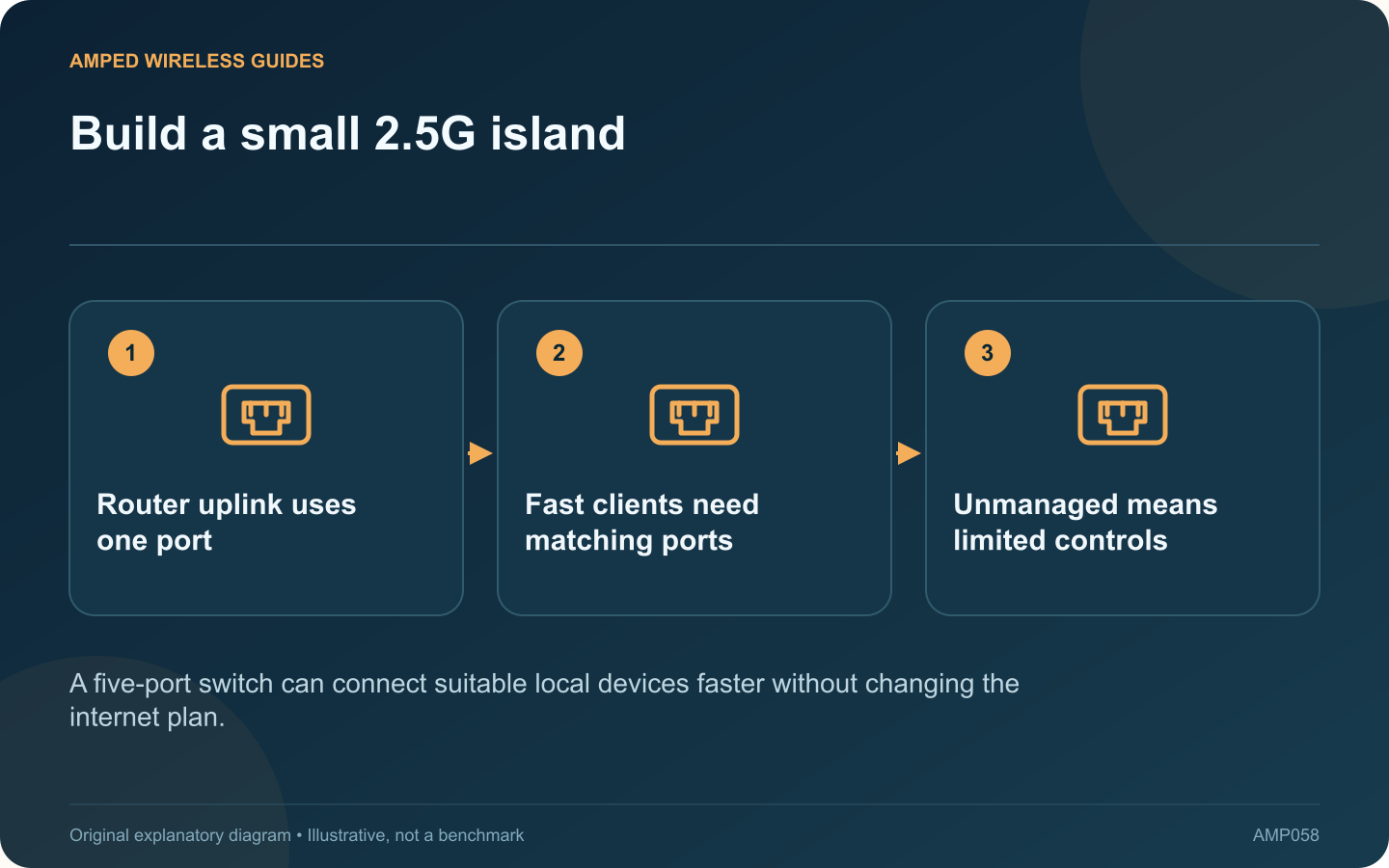
Build a small 2.5G island: Router uplink uses one port; Fast clients need matching ports; Unmanaged means limited controls
A five-port switch can connect suitable local devices faster without changing the internet plan.

The TL-SG105-M2 and NETGEAR MS105 are candidates for a small unmanaged 2.5 Gigabit network segment. Their shared role means the comparison should focus on practical fit rather than inventing a performance winner from brand preference.

List the devices that can use 2.5G

A workstation and storage server with suitable interfaces may benefit from faster local transfers. An older Gigabit device remains limited by its own connection. Check the negotiated rate at each endpoint after installation.

Count the uplink

Both are five-port products in the cited documentation. A connection to the router normally occupies one port, leaving four for other equipment. If the plan already needs five local endpoints, evaluate an appropriate larger switch instead.

Check what unmanaged means for this job

Do not choose either expecting a full management interface for VLAN policy, port mirroring or detailed diagnostics unless the exact documentation provides the required function. A managed product is a different comparison when those controls are essential.

Compare the installation details

  • Dimensions and cable-clearance space.
  • Supported mounting arrangement.
  • Power-supply and regional plug requirements.
  • Current local warranty terms and seller support.
  • Hardware revision and available documentation.

NETGEAR lists the MS105 as fanless. Follow each selected model’s ventilation instructions; quiet operation does not mean a switch can be buried under papers or stacked against a heat source.

Test local and internet traffic separately

A faster local switch can improve a capable LAN transfer while the internet remains limited by the router or subscription. That is normal. Measure the workload that justified the purchase, not just an online speed test.

Where both devices satisfy the same requirements, total local cost and support may decide the choice. No independent benchmark is claimed here. The useful upgrade is a complete, correctly negotiated path between devices that can actually use the higher rate.

Sources and editorial notes

Sources checked 8–9 October 2026. Independent guidance and original illustrations; product comparisons use published specifications rather than hands-on benchmarks. Check the exact model, revision and regional documentation before changing settings.

Related guides

300 FAQs across our guide libraries

Quick answers

100 practical questions from Amped Wireless Guides.

Browse all 100 FAQs
What should I compare on TL-SG105-M2 and NETGEAR MS105?

The TL-SG105-M2 and NETGEAR MS105 are candidates for a small unmanaged 2.5 Gigabit network segment. Their shared role means the comparison should focus on practical fit rather than inventing a performance winner from brand preference. A workstation and storage server with suitable interfaces may benefit from faster local transfers. An older Gigabit device remains limited by its own connection. Check the negotiated rate at each endpoint after installation.

Read the full guide and sources
Should a home network use a five-port or eight-port switch?

A five-port switch does not normally provide five additional device connections when one port is needed to reach the router. Count the uplink and every planned endpoint before deciding between a compact five-port model and an eight-port alternative. For a television cabinet, the list might include the router uplink, television, console, streaming box and access point. That already occupies five ports. A future receiver or second console would require another arrangement.

Read the full guide and sources
Does adding a second switch uplink automatically increase speed?

Connecting a second ordinary cable between two switches does not automatically double their speed. Without an appropriate supported configuration, the additional path can create an Ethernet loop and disrupt the entire LAN. NETGEAR describes loops as a cause of broadcast storms, irregular connectivity and network failure. If problems began immediately after an extra cable was installed, document that change and review the physical topology before resetting routers or client devices.

Read the full guide and sources
How does switch port isolation differ from VLAN separation?

Port isolation and VLANs can both appear in discussions about separating devices, but they do not mean the same thing. Understanding the difference helps avoid a configuration that blocks one path while leaving another unintended route available. TP-Link's switch configuration guide describes forwarding lists for isolated ports. The exact behavior depends on the switch and firmware. Determine which ports can exchange traffic and which uplink remains reachable in the proposed arrangement.

Read the full guide and sources
Independent. Practical. Clear.

Amped Wireless Guides is an independent information website. We are not affiliated with or endorsed by Amped Wireless. Product names belong to their respective owners.