Independent extender & router guidesHelping you find your connection.
The guide library

Five-port vs eight-port switch: count the uplink before buying

Explore the guide library · Switch selection and setup

The connection back to the router normally consumes one of the switch’s advertised ports.
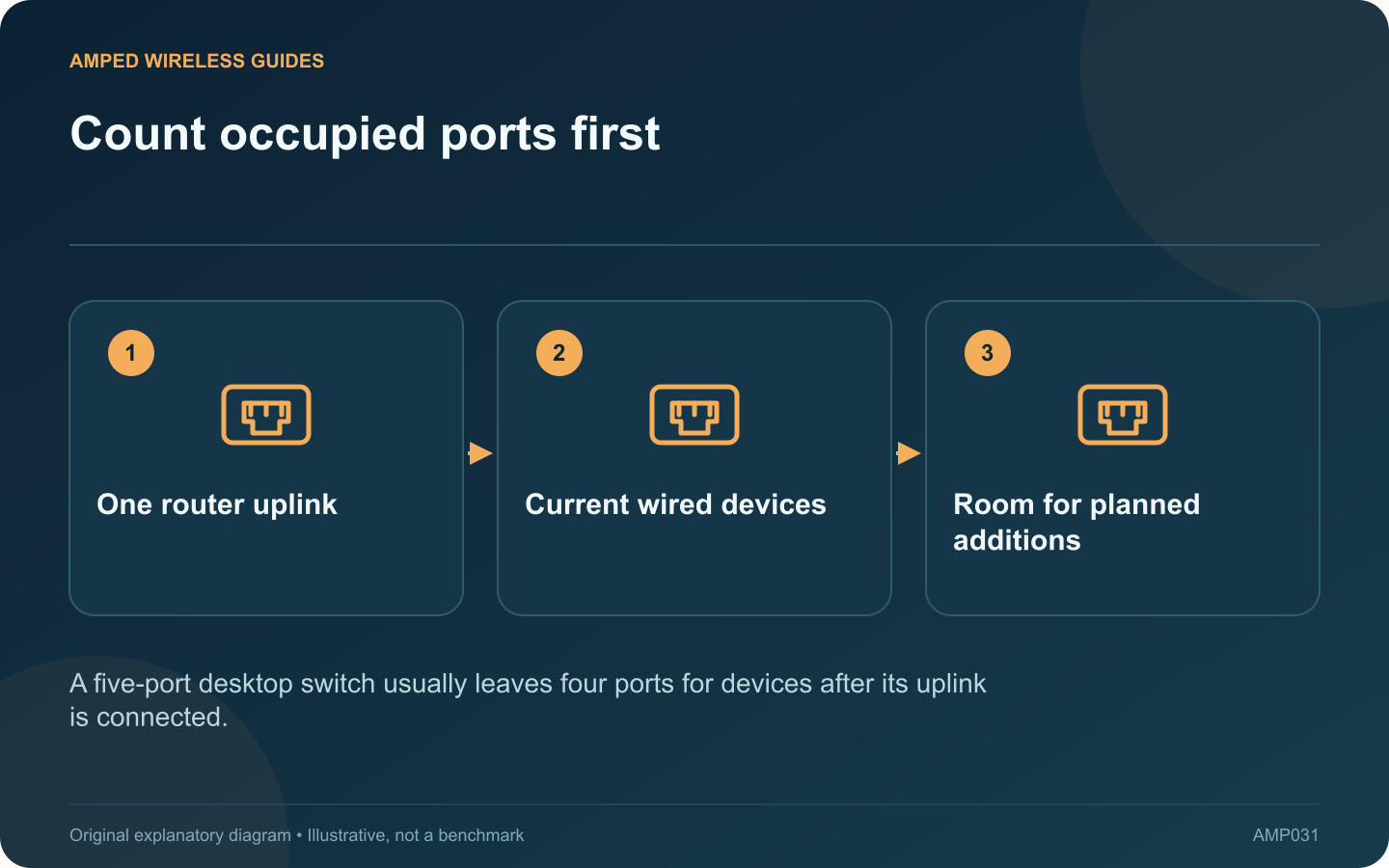
Count occupied ports first: One router uplink; Current wired devices; Room for planned additions
A five-port desktop switch usually leaves four ports for devices after its uplink is connected.

A five-port switch does not normally provide five additional device connections when one port is needed to reach the router. Count the uplink and every planned endpoint before deciding between a compact five-port model and an eight-port alternative.

Make a port list

For a television cabinet, the list might include the router uplink, television, console, streaming box and access point. That already occupies five ports. A future receiver or second console would require another arrangement.

Compare a concrete example

TP-Link’s TL-SG105 and TL-SG108 families provide five and eight Gigabit ports respectively in the cited revision datasheet. The extra ports increase connection capacity; they do not make a single Gigabit device operate at a higher link rate.

Leave sensible headroom

List likely additions over the next year, but avoid buying a much larger unit without a reason. Space, power-adapter placement, ventilation and cable bend clearance matter in a small cabinet as well as the port count.

Check features separately

  • PoE is not implied by an ordinary Ethernet port.
  • Management and VLAN controls depend on the model.
  • Multi-gigabit support requires explicitly rated ports.
  • Fan behavior and mounting options vary by product.

Plan the uplink’s shared use

Several devices can communicate through the switch, but traffic leaving toward the router shares the uplink’s capacity. That may be perfectly adequate for ordinary streaming devices. Evaluate it against the expected simultaneous workload rather than adding every port’s advertised rate and assuming the router receives that total.

After installation, label the uplink and check each endpoint’s connection. Keep one spare port only if it is useful for growth or troubleshooting; unused capacity is a planning choice, not a performance feature. A small port inventory turns the purchase into a straightforward fit decision and avoids adding another switch immediately after the first one arrives.

Sources and editorial notes

Sources checked 8–9 October 2026. Independent guidance and original illustrations; product comparisons use published specifications rather than hands-on benchmarks. Check the exact model, revision and regional documentation before changing settings.

Related guides

300 FAQs across our guide libraries

Quick answers

100 practical questions from Amped Wireless Guides.

Browse all 100 FAQs
Should a home network use a five-port or eight-port switch?

A five-port switch does not normally provide five additional device connections when one port is needed to reach the router. Count the uplink and every planned endpoint before deciding between a compact five-port model and an eight-port alternative. For a television cabinet, the list might include the router uplink, television, console, streaming box and access point. That already occupies five ports. A future receiver or second console would require another arrangement.

Read the full guide and sources
Does adding a second switch uplink automatically increase speed?

Connecting a second ordinary cable between two switches does not automatically double their speed. Without an appropriate supported configuration, the additional path can create an Ethernet loop and disrupt the entire LAN. NETGEAR describes loops as a cause of broadcast storms, irregular connectivity and network failure. If problems began immediately after an extra cable was installed, document that change and review the physical topology before resetting routers or client devices.

Read the full guide and sources
How does switch port isolation differ from VLAN separation?

Port isolation and VLANs can both appear in discussions about separating devices, but they do not mean the same thing. Understanding the difference helps avoid a configuration that blocks one path while leaving another unintended route available. TP-Link's switch configuration guide describes forwarding lists for isolated ports. The exact behavior depends on the switch and firmware. Determine which ports can exchange traffic and which uplink remains reachable in the proposed arrangement.

Read the full guide and sources
When are managed-switch features useful at home?

An unmanaged switch can be sufficient when the task is simply adding wired connections to one ordinary LAN. A managed switch becomes useful when you need specific controls or diagnostics, but those capabilities also require deliberate configuration and maintenance. Examples include separating traffic with VLANs, inspecting port errors, managing supported aggregation or controlling PoE per port. Write down the actual feature needed. Buying a managed model solely because it sounds more professional can add complexity without solving a problem.

Read the full guide and sources
Independent. Practical. Clear.

Amped Wireless Guides is an independent information website. We are not affiliated with or endorsed by Amped Wireless. Product names belong to their respective owners.