Independent extender & router guidesHelping you find your connection.
The guide library

Replace the main Deco during an upgrade without rebuilding the whole network

Explore the guide library · Mesh maintenance

Use the supported main-unit change workflow and verify operating-mode compatibility before moving the internet cable.
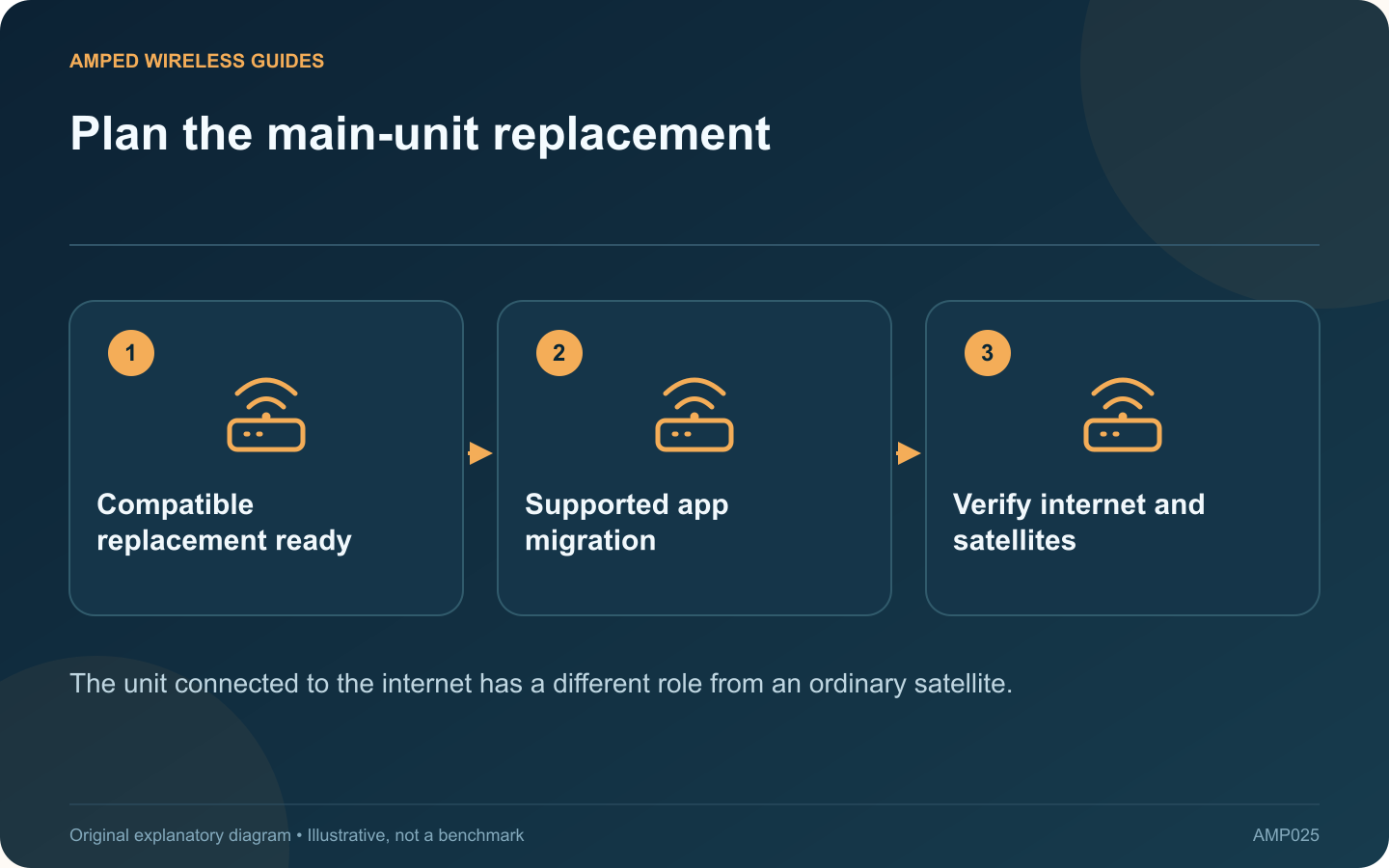
Plan the main-unit replacement: Compatible replacement ready; Supported app migration; Verify internet and satellites
The unit connected to the internet has a different role from an ordinary satellite.

Upgrading the main Deco is a network-role change, not simply adding another satellite. TP-Link provides supported workflows for promoting an existing unit or replacing the main unit while preserving the intended network configuration.

Confirm the replacement fits the role

Check that it supports the current operating mode and required internet connection features. Consider its Ethernet port speeds and the physical ports needed for the gateway and LAN. A faster wireless specification does not compensate for an unsuitable port arrangement.

Prepare while the current network works

Record essential connection information and confirm access to the managing account. Use the vendor’s current replacement instructions. Some migration steps assume the existing main unit remains online, so a planned upgrade differs from recovery after complete hardware failure.

Choose the correct app action

TP-Link distinguishes setting an existing satellite as main from replacing the main unit with a new device. Select the workflow matching your situation and follow its cable and startup sequence. Avoid resetting the entire mesh as a shortcut.

Allow for an interruption

  • Finish active calls and transfers first.
  • Keep the old unit and cables identifiable.
  • Move the internet connection only at the instructed step.
  • Wait for the new main unit to establish service.

Validate the network afterward

Check internet access, satellite status and any wired backhaul. Test local resources and the household controls that matter. If the provider-side gateway does not recognize the replacement connection, follow its documented recovery process rather than inventing addressing settings.

Keep the old unit unchanged until the migration is confirmed successful. Then decide whether it will be reused as a supported satellite or retired through the normal reset and account-removal process.

Save the new topology and model details. A planned replacement is complete when the main unit, satellites and required services work together in the intended mode, not merely when the app displays the new hardware’s name.

Sources and editorial notes

Sources checked 8–9 October 2026. Independent guidance and original illustrations; product comparisons use published specifications rather than hands-on benchmarks. Check the exact model, revision and regional documentation before changing settings.

Related guides

300 FAQs across our guide libraries

Quick answers

100 practical questions from Amped Wireless Guides.

Browse all 100 FAQs
How should I prepare to replace the main Deco unit?

Upgrading the main Deco is a network-role change, not simply adding another satellite. TP-Link provides supported workflows for promoting an existing unit or replacing the main unit while preserving the intended network configuration. Check that it supports the current operating mode and required internet connection features. Consider its Ethernet port speeds and the physical ports needed for the gateway and LAN. A faster wireless specification does not compensate for an unsuitable port arrangement.

Read the full guide and sources
Can wired and wireless Deco satellites share one network?

You do not need Ethernet in every room to benefit from wired backhaul. Deco supports a mixture of wired and wireless satellite connections. The important step is understanding which segments use each method and whether the remaining wireless paths are healthy. Identify rooms with tested Ethernet sockets and note where they connect. A wall plate without a known live upstream port is not yet a usable backhaul. Confirm the network's operating mode before choosing the switch arrangement.

Read the full guide and sources
When are managed-switch features useful at home?

An unmanaged switch can be sufficient when the task is simply adding wired connections to one ordinary LAN. A managed switch becomes useful when you need specific controls or diagnostics, but those capabilities also require deliberate configuration and maintenance. Examples include separating traffic with VLANs, inspecting port errors, managing supported aggregation or controlling PoE per port. Write down the actual feature needed. Buying a managed model solely because it sounds more professional can add complexity without solving a problem.

Read the full guide and sources
Where should a switch connect when Deco runs in Router mode?

When Deco runs in Router mode, the main unit separates its upstream internet connection from the network it manages. A switch used for satellite backhaul belongs on the main unit's LAN side. Treating every available Ethernet socket as equivalent can create an incorrect topology. Write the order as internet gateway, main Deco, LAN switch and satellite Decos. TP-Link's wiring guidance places wired satellites behind the main Deco in Router mode. Avoid connecting them to a switch that bypasses the main unit on its upstream side.

Read the full guide and sources
Independent. Practical. Clear.

Amped Wireless Guides is an independent information website. We are not affiliated with or endorsed by Amped Wireless. Product names belong to their respective owners.