Independent extender & router guidesHelping you find your connection.
The guide library

Deco XE75 6 GHz: dedicated backhaul or client network?

Explore the guide library · Coverage design choices

Read the configured role of the 6 GHz radio before assuming a missing client network means the hardware is faulty.
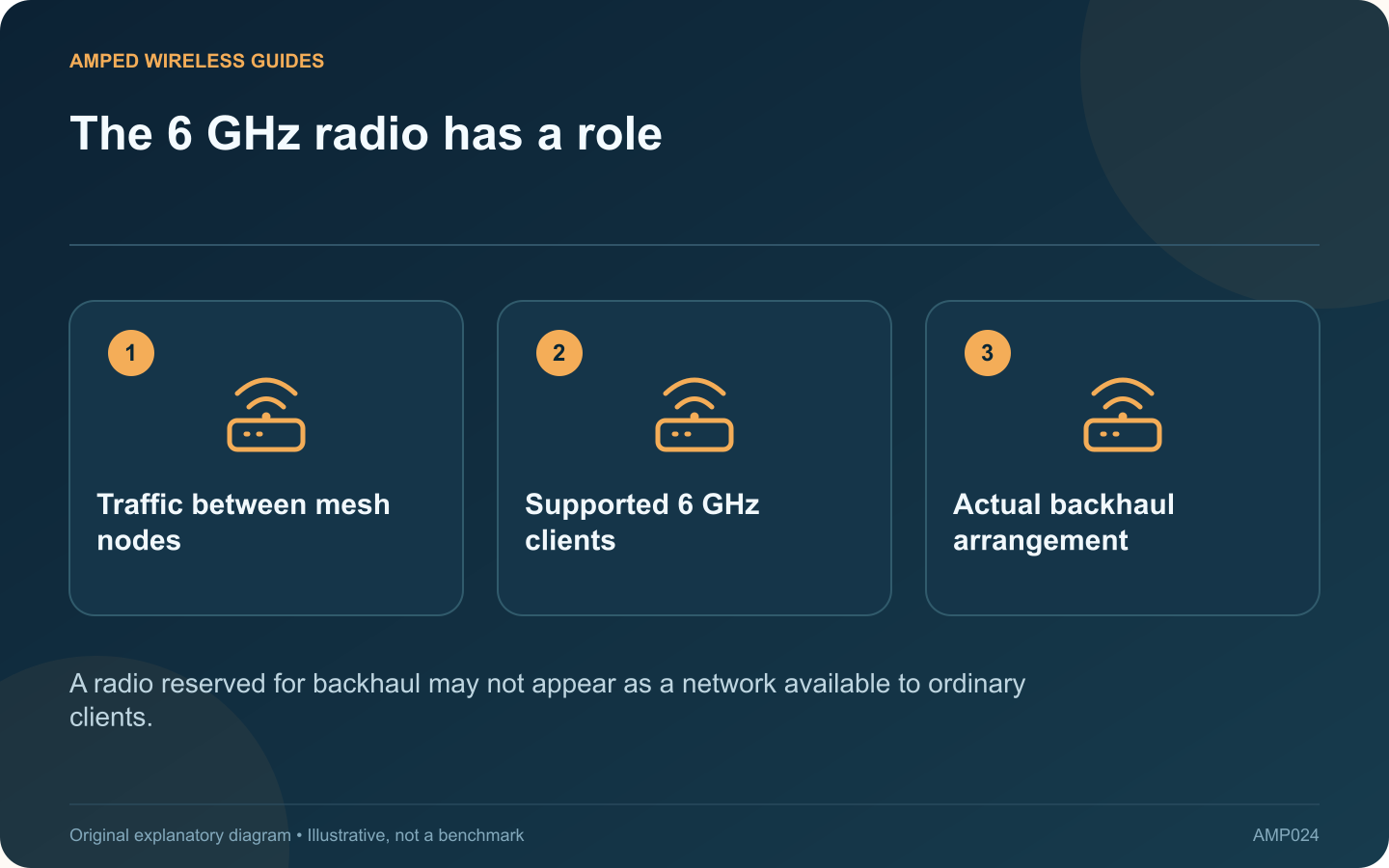
The 6 GHz radio has a role: Traffic between mesh nodes; Supported 6 GHz clients; Actual backhaul arrangement
A radio reserved for backhaul may not appear as a network available to ordinary clients.

A compatible phone may not see a 6 GHz network on a Deco XE75 because that radio is configured for backhaul. The product’s revision-specific manual distinguishes a dedicated-backhaul role from a client Wi-Fi network role.

Read the installed configuration

Open the current Deco wireless settings and inspect the 6 GHz section. Confirm the exact hardware revision and firmware before following a menu path from an older manual. Do not infer the radio’s role solely from the tri-band label on the box.

Identify who needs the band

If the household mainly uses older clients, the 6 GHz radio may still be useful between compatible mesh nodes. If a laptop supports 6 GHz, client access may be relevant, but it must also meet operating-system and regional requirements.

Examine the backhaul plan

A wireless mesh and an Ethernet-wired mesh have different demands on radio capacity. Record how every satellite currently connects before changing the 6 GHz role. A client speed improvement in one room should not conceal a weaker upstream arrangement elsewhere.

Make a purposeful comparison

  1. Record the current band role and node connections.
  2. Test the target client’s normal workload.
  3. Apply a supported configuration suited to the network.
  4. Repeat the client test and check the satellites.

Keep the same location and task. Moving next to the main node while changing the band creates an unfair before-and-after comparison.

Check compatibility without weakening security

Use the prescribed security settings for the 6 GHz network and current supported client software. A device without the required radio cannot gain support by repeatedly forgetting and rejoining the network.

Choose the configuration that serves the whole installation. The meaningful question is how the radio contributes to client access and node connectivity in your home, not whether every advertised band must always appear as a separately selectable network on every device.

Sources and editorial notes

Sources checked 8–9 October 2026. Independent guidance and original illustrations; product comparisons use published specifications rather than hands-on benchmarks. Check the exact model, revision and regional documentation before changing settings.

Related guides

300 FAQs across our guide libraries

Quick answers

100 practical questions from Amped Wireless Guides.

Browse all 100 FAQs
Can Deco XE75 use 6 GHz for both clients and backhaul?

A compatible phone may not see a 6 GHz network on a Deco XE75 because that radio is configured for backhaul. The product's revision-specific manual distinguishes a dedicated-backhaul role from a client Wi-Fi network role. Open the current Deco wireless settings and inspect the 6 GHz section. Confirm the exact hardware revision and firmware before following a menu path from an older manual. Do not infer the radio's role solely from the tri-band label on the box.

Read the full guide and sources
Will adding another mesh node always improve coverage?

Adding another mesh node is tempting when a speed test disappoints, but node count alone does not determine performance. TP-Link explicitly notes that more Deco units do not always improve throughput or stability, especially when there are no coverage gaps. List the rooms and tasks that fail. If performance is poor everywhere, including beside the main router on a wired connection, another wireless node is unlikely to address the primary issue. If one distant room fails, additional coverage may be relevant.

Read the full guide and sources
Are Deco, EasyMesh and OneMesh automatically compatible?

A router and extender from the same manufacturer are not automatically members of the same mesh family. Before purchasing an add-on, verify the exact pairing and the features that pairing supports. Record the router and prospective extender's full model names, hardware revisions and regional versions. Check released firmware requirements. A feature shown as planned should not be treated as available in the product you can buy today.

Read the full guide and sources
Should two extenders connect directly to the router or to each other?

A second extender can cover another area, but connecting it through the first creates a different network path from connecting both directly to the router. The choice affects how many wireless links each client's traffic must cross. In a direct arrangement, each extender receives the router's signal independently. In a daisy chain, the distant extender depends on the first extender as well as its own client connection. TP-Link generally recommends direct host-router connections for better performance.

Read the full guide and sources
Independent. Practical. Clear.

Amped Wireless Guides is an independent information website. We are not affiliated with or endorsed by Amped Wireless. Product names belong to their respective owners.