Independent extender & router guidesHelping you find your connection.
The guide library

Full Wi-Fi bars beside an extender but no internet: test the upstream link

Explore the guide library · Extender connection checks

The signal shown on your phone describes its nearby connection, not every link back to the internet.
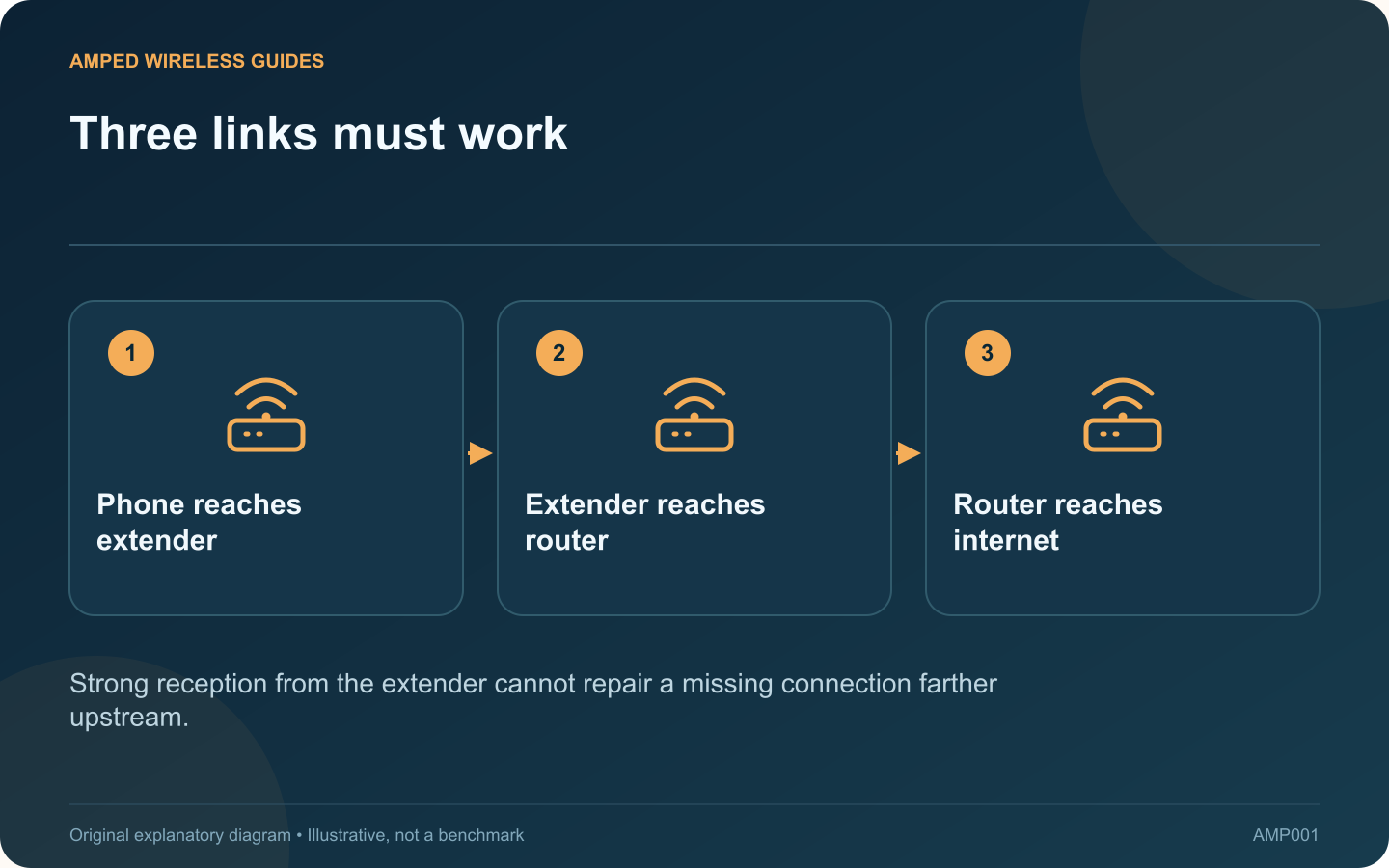
Three links must work: Phone reaches extender; Extender reaches router; Router reaches internet
Strong reception from the extender cannot repair a missing connection farther upstream.

Standing beside an extender can produce full Wi-Fi bars even when web pages will not load. Those bars mainly describe the nearby wireless connection. The extender still needs a working path to the router, and the router needs internet access.

Compare the router directly

Use a known device connected directly to the main router and test an ordinary website. Confirm the phone has not switched to cellular data. If the direct connection also fails, investigate the router or provider before changing extender placement.

Read the extender’s status

Open its supported management interface and inspect the host-network connection. TP-Link’s troubleshooting documentation distinguishes the router-to-extender link from internet status. Use the manual for your model because LED names and colors are not universal.

Separate association from addressing

A client can join Wi-Fi but fail to receive the network settings needed for useful access. Note whether the device reports an address and gateway. Do not add a second DHCP server or copy a random static address as a first response.

Try a controlled location test

  1. Keep the existing configuration recorded.
  2. Move the extender nearer to the router temporarily.
  3. Wait for its normal startup and host connection.
  4. Test the same client and website.

If that restores access while the direct router connection was always healthy, the extender’s upstream wireless path deserves attention. If it does not, review configuration and supported firmware rather than assuming distance is the only explanation.

Finish at the intended location

Once the cause is addressed, return to the room that needs coverage and repeat the actual task. Check both the extender’s host-link status and the client experience.

A successful test beside the extender is useful only when the entire path works. Keep the three stages separate in your notes so future failures can be narrowed down without resetting every device or repeatedly buying stronger-looking wireless hardware.

Sources and editorial notes

Sources checked 8–9 October 2026. Independent guidance and original illustrations; product comparisons use published specifications rather than hands-on benchmarks. Check the exact model, revision and regional documentation before changing settings.

Related guides

300 FAQs across our guide libraries

Quick answers

100 practical questions from Amped Wireless Guides.

Browse all 100 FAQs
Why can an extender show full Wi-Fi bars but have no internet?

Standing beside an extender can produce full Wi-Fi bars even when web pages will not load. Those bars mainly describe the nearby wireless connection. The extender still needs a working path to the router, and the router needs internet access. Use a known device connected directly to the main router and test an ordinary website. Confirm the phone has not switched to cellular data. If the direct connection also fails, investigate the router or provider before changing extender placement.

Read the full guide and sources
Why can an extender change the device identity seen by router rules?

A router rule tied to a device's MAC address may behave differently after that device joins through an extender. Some extenders use a proxy arrangement that presents a translated address upstream. The router may therefore be applying the rule to a different identifier than you expect. TP-Link documents virtual client MAC addresses for particular proxy-mode extender arrangements. This is not a universal description of every extender, access point or mesh system. Read the instructions for the exact model and operating mode.

Read the full guide and sources
Does plugging a television into an extender create wired backhaul?

Connecting a television or console to an extender's Ethernet port can be useful, especially when the device's own wireless adapter is weak. However, if the extender connects to the router over Wi-Fi, the stream still depends on that wireless backhaul. Write the sequence as television, cable, extender, wireless link, router and internet. TP-Link describes this Ethernet bridge function on supported extenders. The cable changes the client-facing segment; it does not replace the radio connection between the extender and router.

Read the full guide and sources
Why can an extender fail to see the router’s 5 GHz network?

An extender finding the router's 2.4 GHz network but missing its 5 GHz network has a narrower problem than a completely failed setup. Confirm the router's 5 GHz radio and the extender's supported channels before resetting the device. Use another compatible client near the router to check its 5 GHz network. If that client cannot see it either, inspect the router first. When both bands share one name, use the router's status information to verify which band the test client actually joined.

Read the full guide and sources
Independent. Practical. Clear.

Amped Wireless Guides is an independent information website. We are not affiliated with or endorsed by Amped Wireless. Product names belong to their respective owners.