Independent extender & router guidesHelping you find your connection.
The guide library

ASUS ZenWiFi XD5 vs XT9: decide around the backhaul plan

Explore the guide library · Extender and mesh comparisons

Compare a compact dual-band system with a tri-band option using the actual node connections you intend to install.
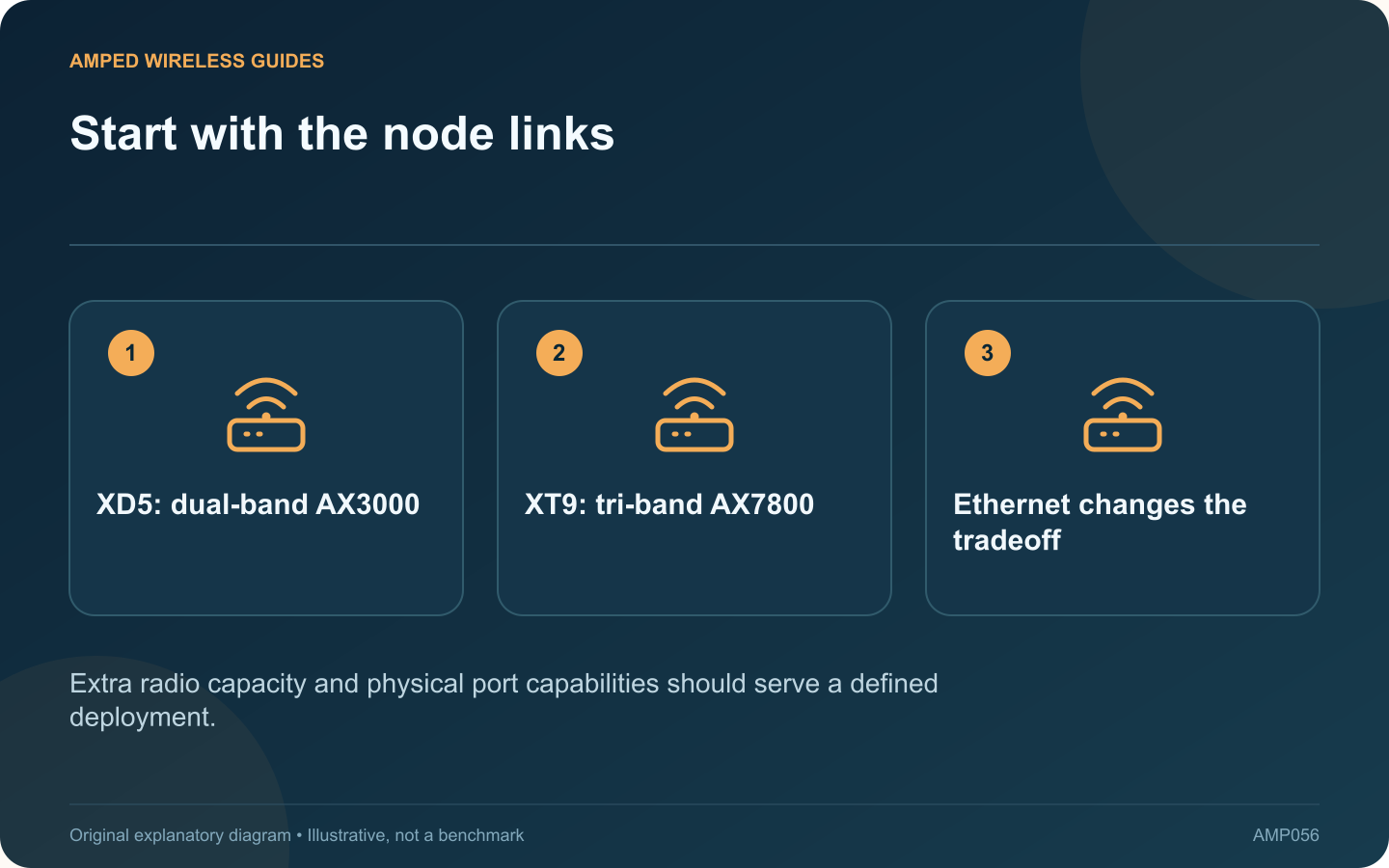
Start with the node links: XD5: dual-band AX3000; XT9: tri-band AX7800; Ethernet changes the tradeoff
Extra radio capacity and physical port capabilities should serve a defined deployment.

ASUS positions the ZenWiFi XD5 as a dual-band AX3000 system and the XT9 as a tri-band AX7800 system. The additional radio arrangement makes the backhaul plan central to a useful comparison.

If the nodes connect wirelessly

Examine how the proposed system allocates its radios between clients and node communication. A tri-band design offers options that a dual-band design does not, but real results still depend on node placement, interference and the building. Do not convert the combined wireless class directly into an expected client download speed.

If Ethernet reaches each node

ASUS documents Ethernet Backhaul Mode and per-node backhaul priorities for supported AiMesh equipment. With a reliable wired path, compare the client radios, physical connections and price instead of assuming that extra wireless backhaul capacity is essential.

Check physical constraints

The XD5 specification lists two Gigabit Ethernet connections, with a configurable WAN/LAN role on one. The XT9 product page highlights a 2.5 Gigabit WAN connection. Map every required wired device and verify the complete local specification before ordering.

Compare the full ownership plan

  • Number of nodes actually required.
  • Current firmware support for the exact model.
  • Guest and management features in the intended operating mode.
  • Space and power at suitable node locations.

Trial the distant node

Test a call or transfer through the satellite where service currently fails. Compare it with a client near the main router. That separates a weak node connection from a problem affecting the whole internet service.

The XD5 can be a candidate for a compact, suitably wired or modest deployment. The XT9 merits investigation where its tri-band arrangement or documented port capability addresses a specific need. These are planning conclusions from manufacturer specifications; they do not establish measured coverage or a universal performance winner in every home.

Sources and editorial notes

Sources checked 8–9 October 2026. Independent guidance and original illustrations; product comparisons use published specifications rather than hands-on benchmarks. Check the exact model, revision and regional documentation before changing settings.

Related guides

300 FAQs across our guide libraries

Quick answers

100 practical questions from Amped Wireless Guides.

Browse all 100 FAQs
How should backhaul affect an XD5 versus XT9 decision?

ASUS positions the ZenWiFi XD5 as a dual-band AX3000 system and the XT9 as a tri-band AX7800 system. The additional radio arrangement makes the backhaul plan central to a useful comparison. Examine how the proposed system allocates its radios between clients and node communication. A tri-band design offers options that a dual-band design does not, but real results still depend on node placement, interference and the building. Do not convert the combined wireless class directly into an expected client download speed.

Read the full guide and sources
What should I verify when comparing Deco BE25 and BE63?

The cited Deco BE25 revision 1 and BE63 specifications illustrate why Wi-Fi generation alone is insufficient for choosing a mesh kit. The BE25 version covers 2.4 and 5 GHz with two 2.5 Gigabit ports; the BE63 adds 6 GHz and lists four 2.5 Gigabit ports per unit. At the main router, one port serves the upstream connection. At a wired satellite, one may serve backhaul. Write down how many physical connections remain for a desktop, television or storage device. Extra ports can avoid a separate switch where space is limited.

Read the full guide and sources
When might RE655BE improve on an RE715X installation?

The RE655BE adds capabilities beyond the RE715X, but whether they help depends on the entire connection. A weak upstream signal or an older client can matter more than the generation printed on the extender. The cited RE715X EU revision 2.0 datasheet describes dual-band Wi-Fi 6 and a Gigabit Ethernet port. TP-Link's US RE655BE page describes tri-band Wi-Fi 7, including 6 GHz, and a 2.5 Gigabit port. Regional versions and channel availability must be checked before buying locally.

Read the full guide and sources
What practical difference separates NETGEAR EAX15 and EAX20?

The EAX15 and EAX20 both appear in NETGEAR's AX1800 Wi-Fi 6 extender range. Their physical layouts and Ethernet connections provide a clearer practical distinction than the shared speed-class label. The cited EAX15 datasheet lists one Gigabit Ethernet port; the EAX20 datasheet lists four. A television cabinet with several wired endpoints may therefore fit the EAX20's layout more naturally. Check the current hardware revision before purchasing because model families can change.

Read the full guide and sources
Independent. Practical. Clear.

Amped Wireless Guides is an independent information website. We are not affiliated with or endorsed by Amped Wireless. Product names belong to their respective owners.