Independent extender & router guidesHelping you find your connection.
The guide library

RE655BE vs RE715X: when a Wi-Fi 7 extender upgrade has a purpose

Explore the guide library · Extender and mesh comparisons

Compare the available bands, Ethernet port and upstream router before paying for a newer radio generation.
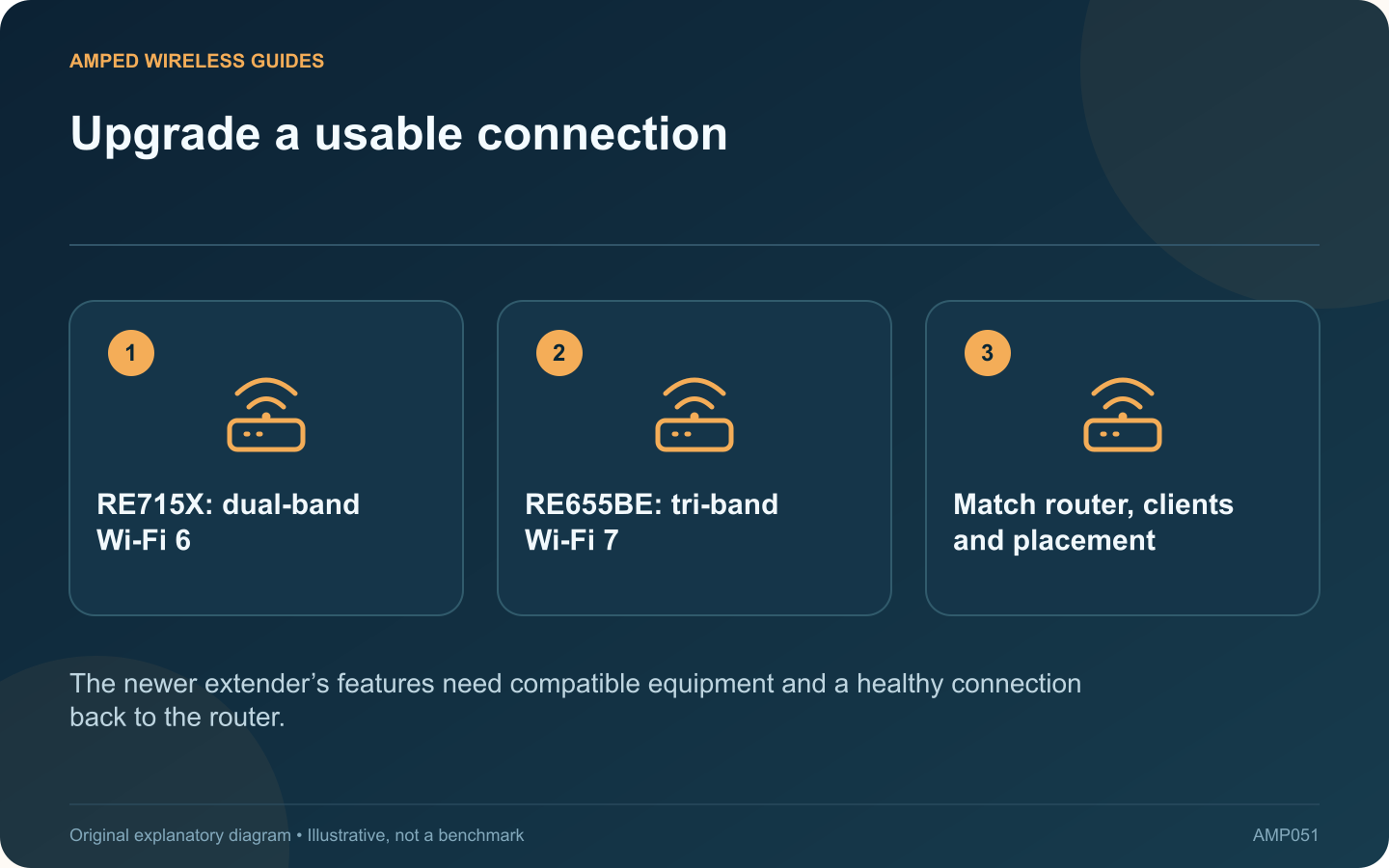
Upgrade a usable connection: RE715X: dual-band Wi-Fi 6; RE655BE: tri-band Wi-Fi 7; Match router, clients and placement
The newer extender’s features need compatible equipment and a healthy connection back to the router.

The RE655BE adds capabilities beyond the RE715X, but whether they help depends on the entire connection. A weak upstream signal or an older client can matter more than the generation printed on the extender.

Compare the documented hardware

The cited RE715X EU revision 2.0 datasheet describes dual-band Wi-Fi 6 and a Gigabit Ethernet port. TP-Link’s US RE655BE page describes tri-band Wi-Fi 7, including 6 GHz, and a 2.5 Gigabit port. Regional versions and channel availability must be checked before buying locally.

Identify the intended benefit

Need Relevant comparison
Compatible 6 GHz client access RE655BE’s additional band
Faster wired access-point uplink Port speed and supported operating mode
One ordinary dead spot Placement and existing client requirements

Inspect the upstream router

An extender cannot create radio capabilities at the router that the router does not support. Check the actual band and mode available for their connection. For a wired installation, verify the router or switch port and cable path as well.

Separate specifications from results

Wireless class numbers combine theoretical rates and do not describe one application’s throughput. This comparison is based on manufacturer specifications, not a hands-on speed measurement. Avoid interpreting a larger class as a guaranteed improvement through the same difficult wall.

Make placement part of the trial

Locate the extender where it can still maintain a suitable upstream link, then test the destination room. Repeat the workload that originally failed, such as a call or local transfer, with the same client.

The RE655BE is a more relevant candidate when its additional band or faster port solves a real requirement. If the requirement is simply stable access for existing devices, first establish whether a correctly placed supported RE715X-class solution already meets it.

Sources and editorial notes

Sources checked 8–9 October 2026. Independent guidance and original illustrations; product comparisons use published specifications rather than hands-on benchmarks. Check the exact model, revision and regional documentation before changing settings.

Related guides

300 FAQs across our guide libraries

Quick answers

100 practical questions from Amped Wireless Guides.

Browse all 100 FAQs
When might RE655BE improve on an RE715X installation?

The RE655BE adds capabilities beyond the RE715X, but whether they help depends on the entire connection. A weak upstream signal or an older client can matter more than the generation printed on the extender. The cited RE715X EU revision 2.0 datasheet describes dual-band Wi-Fi 6 and a Gigabit Ethernet port. TP-Link's US RE655BE page describes tri-band Wi-Fi 7, including 6 GHz, and a 2.5 Gigabit port. Regional versions and channel availability must be checked before buying locally.

Read the full guide and sources
Do both RE405BE and RE655BE include a 6 GHz radio?

Two extenders can both support Wi-Fi 7 while serving different frequency bands. TP-Link's US RE405BE is a dual-band model, whereas the RE655BE is tri-band with 6 GHz. That is a more useful starting point than comparing the Wi-Fi 7 badge alone. Inventory the laptops and phones that need improved service. Confirm their actual wireless hardware and operating-system support. An older device using 2.4 or 5 GHz does not move to 6 GHz merely because the extender offers it.

Read the full guide and sources
Why does the Ethernet port matter when comparing RE235BE and RE315?

When an extender will use Ethernet, its port specification deserves as much attention as its wireless class. The cited RE315 revision 1 page lists a 10/100 Mbps port, while the RE235BE EU revision 1 datasheet lists a 2.5 Gigabit Ethernet port. In access-point mode, a wired link feeds the wireless network. In extender mode, the port may connect a nearby wired device while the upstream link remains wireless. Confirm the exact model's supported modes before assuming either arrangement.

Read the full guide and sources
What practical difference separates NETGEAR EAX15 and EAX20?

The EAX15 and EAX20 both appear in NETGEAR's AX1800 Wi-Fi 6 extender range. Their physical layouts and Ethernet connections provide a clearer practical distinction than the shared speed-class label. The cited EAX15 datasheet lists one Gigabit Ethernet port; the EAX20 datasheet lists four. A television cabinet with several wired endpoints may therefore fit the EAX20's layout more naturally. Check the current hardware revision before purchasing because model families can change.

Read the full guide and sources
Independent. Practical. Clear.

Amped Wireless Guides is an independent information website. We are not affiliated with or endorsed by Amped Wireless. Product names belong to their respective owners.