Independent extender & router guidesHelping you find your connection.
The guide library

RE405BE vs RE655BE: Wi-Fi 7 does not always include 6 GHz

Explore the guide library · Extender and mesh comparisons

Read the frequency list: these Wi-Fi 7 extenders have different radio-band arrangements.
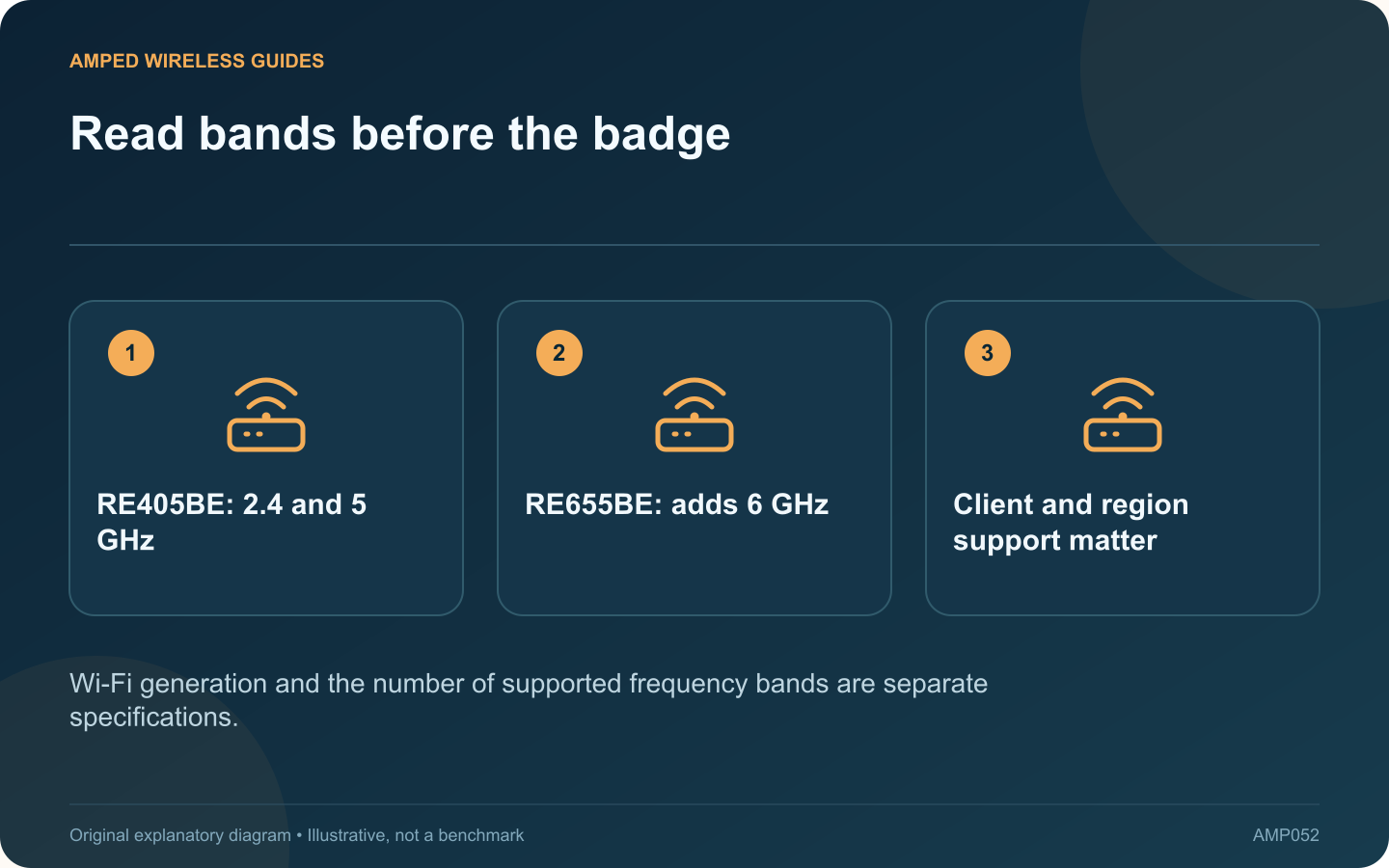
Read bands before the badge: RE405BE: 2.4 and 5 GHz; RE655BE: adds 6 GHz; Client and region support matter
Wi-Fi generation and the number of supported frequency bands are separate specifications.

Two extenders can both support Wi-Fi 7 while serving different frequency bands. TP-Link’s US RE405BE is a dual-band model, whereas the RE655BE is tri-band with 6 GHz. That is a more useful starting point than comparing the Wi-Fi 7 badge alone.

Check which devices could use 6 GHz

Inventory the laptops and phones that need improved service. Confirm their actual wireless hardware and operating-system support. An older device using 2.4 or 5 GHz does not move to 6 GHz merely because the extender offers it.

Consider the location

An additional band gives another connection option, but walls, distance and placement still affect it. Test the rooms that matter. Do not infer whole-house performance from a theoretical rate or a demonstration beside the extender.

Compare the wired alternative

Both cited product pages describe a 2.5 Gigabit port and access-point operation. If Ethernet reaches the desired location, evaluate this supported mode separately from wireless repeating. Confirm that the connected switch or router can negotiate the intended rate.

Check advanced-feature dependencies

Capabilities such as Multi-Link Operation need compatible hardware and software on the participating devices. Read the vendor’s current mode and firmware notes rather than assuming that every Wi-Fi 7 feature applies to every upstream router and client combination.

Choose from a short requirement list

  • Required frequency bands.
  • Wireless versus Ethernet upstream path.
  • Exact mesh compatibility.
  • Regional availability and supported firmware.
  • Performance in the intended rooms.

The RE655BE deserves consideration when a usable 6 GHz path is part of the plan. The RE405BE may fit a dual-band requirement without that extra radio. This is a specification-based distinction, not a claim that either unit wins every speed test. The useful purchase is the one whose additional capabilities will actually be exercised by the network you are building.

Sources and editorial notes

Sources checked 8–9 October 2026. Independent guidance and original illustrations; product comparisons use published specifications rather than hands-on benchmarks. Check the exact model, revision and regional documentation before changing settings.

Related guides

300 FAQs across our guide libraries

Quick answers

100 practical questions from Amped Wireless Guides.

Browse all 100 FAQs
Do both RE405BE and RE655BE include a 6 GHz radio?

Two extenders can both support Wi-Fi 7 while serving different frequency bands. TP-Link's US RE405BE is a dual-band model, whereas the RE655BE is tri-band with 6 GHz. That is a more useful starting point than comparing the Wi-Fi 7 badge alone. Inventory the laptops and phones that need improved service. Confirm their actual wireless hardware and operating-system support. An older device using 2.4 or 5 GHz does not move to 6 GHz merely because the extender offers it.

Read the full guide and sources
Why does the Ethernet port matter when comparing RE235BE and RE315?

When an extender will use Ethernet, its port specification deserves as much attention as its wireless class. The cited RE315 revision 1 page lists a 10/100 Mbps port, while the RE235BE EU revision 1 datasheet lists a 2.5 Gigabit Ethernet port. In access-point mode, a wired link feeds the wireless network. In extender mode, the port may connect a nearby wired device while the upstream link remains wireless. Confirm the exact model's supported modes before assuming either arrangement.

Read the full guide and sources
When might RE655BE improve on an RE715X installation?

The RE655BE adds capabilities beyond the RE715X, but whether they help depends on the entire connection. A weak upstream signal or an older client can matter more than the generation printed on the extender. The cited RE715X EU revision 2.0 datasheet describes dual-band Wi-Fi 6 and a Gigabit Ethernet port. TP-Link's US RE655BE page describes tri-band Wi-Fi 7, including 6 GHz, and a 2.5 Gigabit port. Regional versions and channel availability must be checked before buying locally.

Read the full guide and sources
When is the XE75 Pro’s 2.5G port useful compared with XE75?

The XE75 and XE75 Pro are both presented as tri-band Wi-Fi 6E systems. A key wired difference is that the XE75 has three Gigabit ports, while the XE75 Pro has one 2.5 Gigabit port and two Gigabit ports per unit. If the Pro's faster port connects to a multi-gigabit internet gateway, the remaining ports are still Gigabit. A cable from one of those ports to a downstream switch does not become 2.5 Gigabit because the internet-facing connection is faster.

Read the full guide and sources
Independent. Practical. Clear.

Amped Wireless Guides is an independent information website. We are not affiliated with or endorsed by Amped Wireless. Product names belong to their respective owners.