Independent extender & router guidesHelping you find your connection.
The guide library

Passive PoE vs 802.3af/at: do not choose an injector by voltage alone

Explore the guide library · PoE power planning

Match the powered device’s documented standard and electrical requirements before connecting an injector.
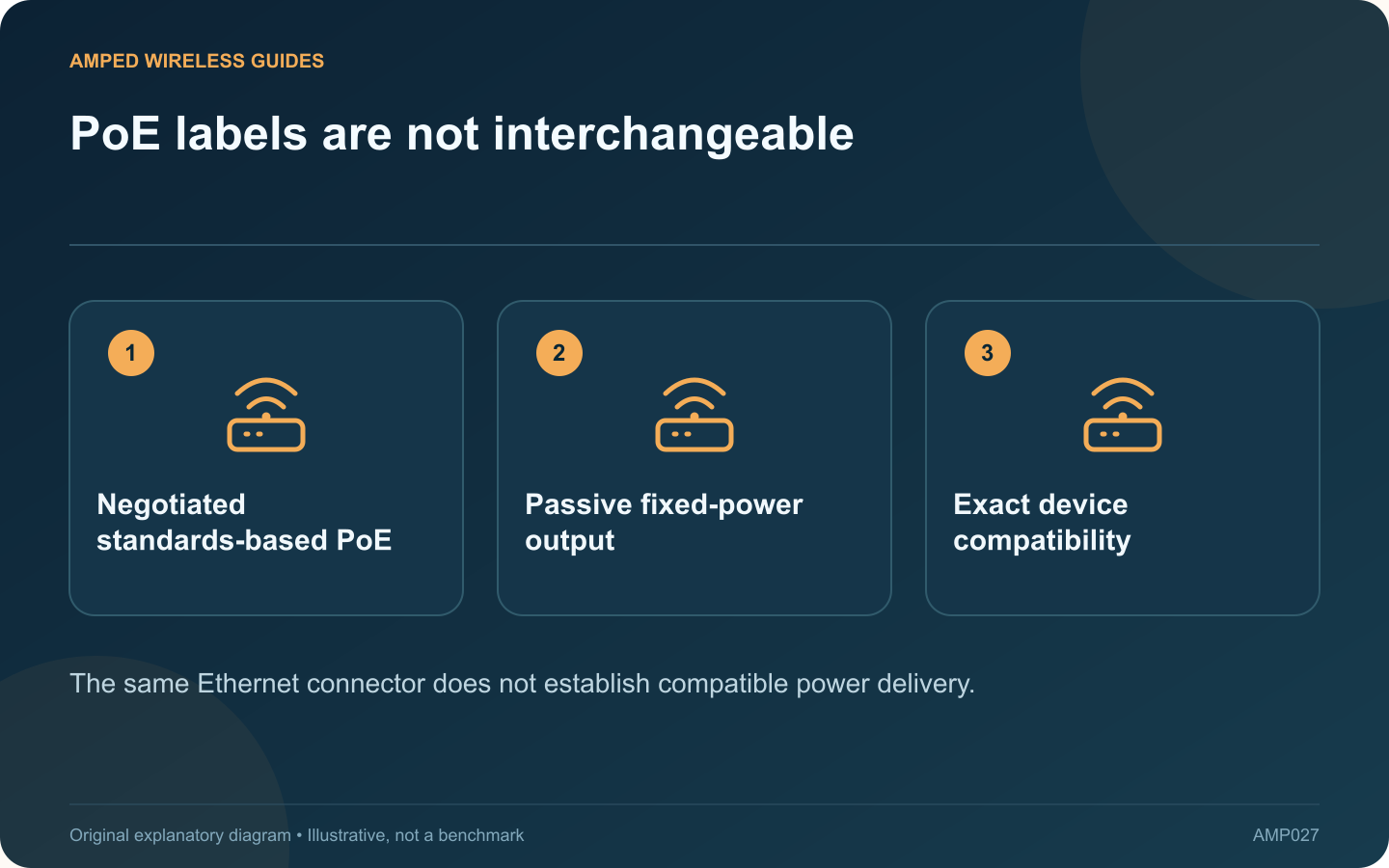
PoE labels are not interchangeable: Negotiated standards-based PoE; Passive fixed-power output; Exact device compatibility
The same Ethernet connector does not establish compatible power delivery.

A device labelled “PoE” may require standards-based 802.3af, 802.3at or 802.3bt power, or it may use a particular passive arrangement. These are not interchangeable merely because both use an Ethernet cable.

Read the powered device’s specification

Find the exact input requirement for the access point, outdoor radio or camera. Record the standard and any stated voltage, polarity and wiring requirements. If the documentation is unclear, obtain confirmation from the manufacturer before connecting power.

Understand the important difference

TP-Link describes standards-based active PoE as checking compatibility before supplying operating power. Passive equipment can place a specified output on the cable without that negotiation. An incompatible passive source can damage connected hardware.

Check both labels

Compare the injector or switch output with the receiving device’s input. Do not rely on a seller’s broad statement that an adapter is “48V PoE compatible.” The required standard and electrical arrangement matter in addition to the voltage number.

Keep data and powered ports distinct

  • Identify the injector’s data input.
  • Identify its powered output.
  • Trace the output only to the intended compatible device.
  • Label passive-power cables to prevent later confusion.

A patch cabinet may be rearranged by someone who assumes every RJ45 socket is an ordinary network connection. Clear labeling is particularly valuable when a passive system is present.

Avoid improvised conversions

Use only a manufacturer-supported converter or replacement power source where conversion is needed. A mechanical connector adapter does not necessarily change the electrical behavior.

If equipment has already been connected incorrectly and behaves abnormally, disconnect it safely and seek vendor guidance rather than repeatedly cycling incompatible power. The correct purchase decision starts with the receiving device’s documented requirement, then selects a source that explicitly meets it. Familiar plugs and matching-looking voltage labels are insufficient evidence of a safe, supported combination.

Sources and editorial notes

Sources checked 8–9 October 2026. Independent guidance and original illustrations; product comparisons use published specifications rather than hands-on benchmarks. Check the exact model, revision and regional documentation before changing settings.

Related guides

300 FAQs across our guide libraries

Quick answers

100 practical questions from Amped Wireless Guides.

Browse all 100 FAQs
Is passive PoE interchangeable with 802.3af or 802.3at?

A device labelled “PoE” may require standards-based 802.3af, 802.3at or 802.3bt power, or it may use a particular passive arrangement. These are not interchangeable merely because both use an Ethernet cable. Find the exact input requirement for the access point, outdoor radio or camera. Record the standard and any stated voltage, polarity and wiring requirements. If the documentation is unclear, obtain confirmation from the manufacturer before connecting power.

Read the full guide and sources
Should I power one access point with an injector or a PoE switch?

A standalone PoE injector can add power to one Ethernet path without replacing a working non-PoE switch. A PoE switch combines multiple data and power connections. Choose between them based on the installation you expect to maintain. For one access point, an injector may be a simple addition. For several access points and cameras, separate injectors create more power adapters and cables to organize. Include likely near-term additions rather than counting only today's first device.

Read the full guide and sources
How do I calculate a PoE switch’s required power budget?

A PoE switch has two important power limits: what an individual port can supply and what all active ports can supply together. Counting free sockets alone is not enough when adding access points, cameras or phones. For each powered device, record its required PoE standard, documented maximum or allocated power requirement and intended switch port. Use the exact model's datasheet. A typical consumption figure may exclude features such as a camera's heater or infrared illumination.

Read the full guide and sources
How can I find a wired access point’s management address?

A wired access point can provide working Wi-Fi while its old setup address no longer opens. Once installed, its management address may come from the main router or a managed configuration rather than the factory value printed in an old guide. Determine whether the product is managed through a controller, an app or a standalone local interface. Use the supported method for its current operating mode. A controller-managed access point may not expose the same controls as a standalone one.

Read the full guide and sources
Independent. Practical. Clear.

Amped Wireless Guides is an independent information website. We are not affiliated with or endorsed by Amped Wireless. Product names belong to their respective owners.