Independent extender & router guidesHelping you find your connection.
The guide library

Permanent link vs channel: include the patch cords in your Ethernet plan

Explore the guide library · Cabling and fiber

The wall cable and the complete equipment-to-equipment path are different test objects.
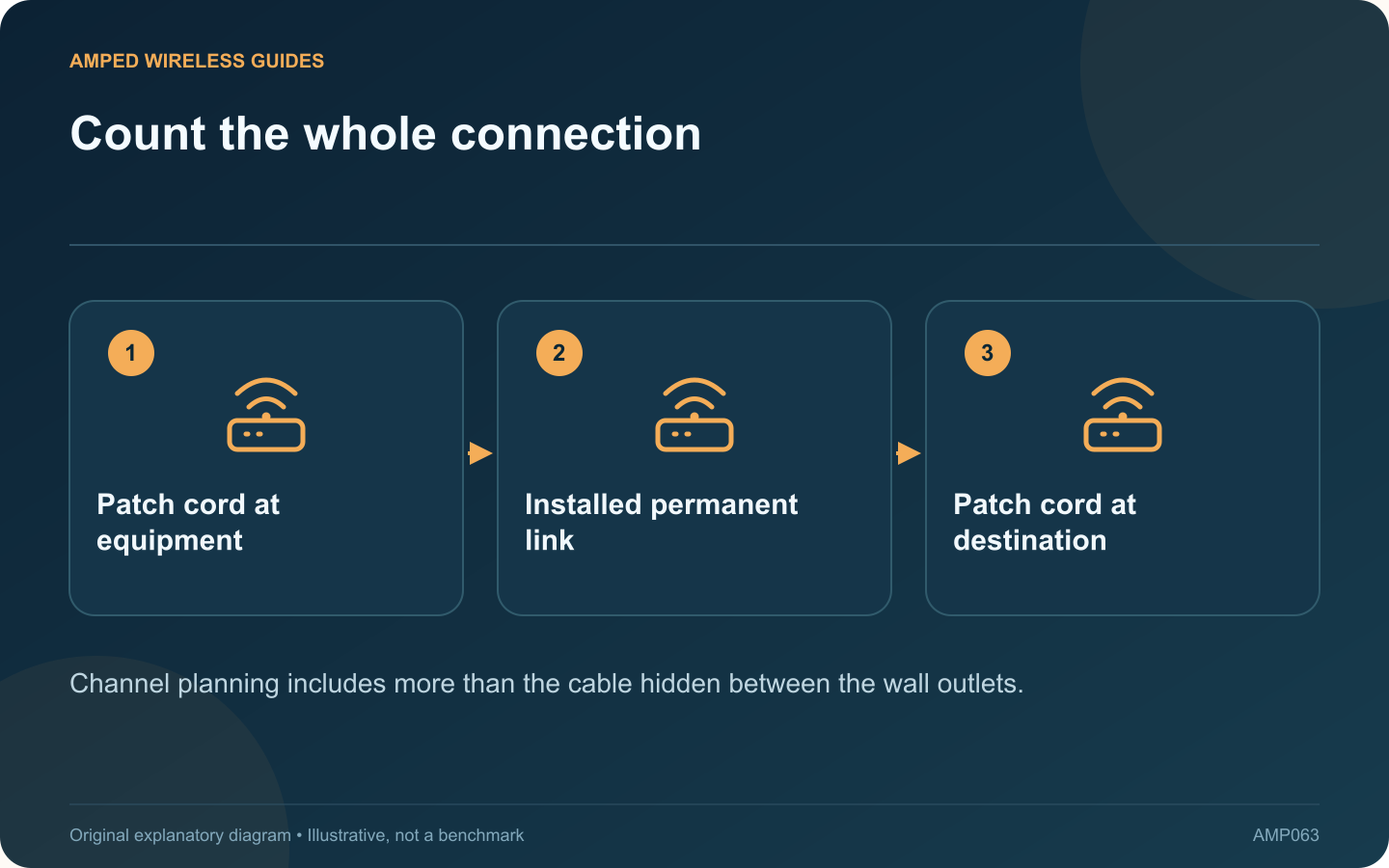
Count the whole connection: Patch cord at equipment; Installed permanent link; Patch cord at destination
Channel planning includes more than the cable hidden between the wall outlets.

A structured cabling plan should distinguish the permanent link from the complete channel. The permanent link is the installed fixed cabling and its associated terminations; the channel also includes the equipment connections used to complete the path.

Measure the route you will install

Do not use the straight-line distance between rooms as the cable length. Include the actual route through permitted spaces, termination locations and appropriate service allowance. An installer should confirm the design before the cable is ordered.

Keep patch cords in the budget

Fluke Networks describes the familiar 90-meter permanent-link and 100-meter channel limits for the relevant standard copper arrangement. These are not permission to add arbitrary extension leads to a maximum-length fixed run. Cable construction and other conditions can require further limits.

Choose the correct acceptance test

If the job is to install permanent links, request the appropriate permanent-link test. A channel result obtained with particular patch cords answers a different question. Record the test configuration so future technicians understand what was measured.

Watch later changes

  • A desk move can add a longer patch lead.
  • A cabinet reorganization can add couplers.
  • Thin patch cords may have specific length restrictions.
  • Replacing connectors can change the link’s performance.

Document the final arrangement

Label both ends, save the test report and note the intended application. If a later upgrade fails, those records help distinguish an original installation problem from a change made afterward.

For an unusually long route, ask the installer to compare a different equipment location or suitable fiber design rather than extending copper beyond its supported plan. The useful objective is a complete tested connection with clear limits. A good length calculation includes the parts people can see and replace, not only the fixed cable concealed in the building.

Sources and editorial notes

Sources checked 8–9 October 2026. Independent guidance and original illustrations; product comparisons use published specifications rather than hands-on benchmarks. Check the exact model, revision and regional documentation before changing settings.

Related guides

300 FAQs across our guide libraries

Quick answers

100 practical questions from Amped Wireless Guides.

Browse all 100 FAQs
How does an Ethernet permanent link differ from a channel?

A structured cabling plan should distinguish the permanent link from the complete channel. The permanent link is the installed fixed cabling and its associated terminations; the channel also includes the equipment connections used to complete the path. Do not use the straight-line distance between rooms as the cable length. Include the actual route through permitted spaces, termination locations and appropriate service allowance. An installer should confirm the design before the cable is ordered.

Read the full guide and sources
What belongs in a fiber link plan for a detached building?

A detached office can benefit from a planned fiber connection when distance, electrical considerations or future capacity make an ordinary copper run unsuitable. The useful comparison includes the whole installation, not simply the price of a fiber patch cable. List the wired devices and wireless coverage required. The remote building normally needs suitable network equipment and its own power arrangement. Optical fiber does not deliver conventional Ethernet PoE to an access point at the other end.

Read the full guide and sources
What should I check before choosing slim Ethernet patch cords?

Small-diameter Ethernet patch cords can reduce clutter in a dense cabinet. Their flexibility and size are useful, but they should be selected from documented specifications rather than treated as electrically identical to every thicker cord. Leviton's guidance explains that smaller conductors can increase insertion loss and require changes to the permitted channel length. A category label alone does not tell you how a particular cord should be used in a nearly maximum-length installation.

Read the full guide and sources
Does passing an Ethernet continuity test certify cable performance?

A basic tester can show that conductors connect from one end of an Ethernet cable to the other. That is useful, but it does not establish every performance characteristic needed for a fast or professionally specified installation. Are you finding a broken patch lead, checking whether a link can support a target application, or accepting newly installed category-rated cabling? Those are different tasks. Fluke Networks distinguishes verification, qualification and certification to address them.

Read the full guide and sources
Independent. Practical. Clear.

Amped Wireless Guides is an independent information website. We are not affiliated with or endorsed by Amped Wireless. Product names belong to their respective owners.