Independent extender & router guidesHelping you find your connection.
The guide library

An Ethernet continuity test is not cable certification

Explore the guide library · Cabling and fiber

Choose a test that answers whether conductors connect, an application works, or an installed link meets a cabling standard.
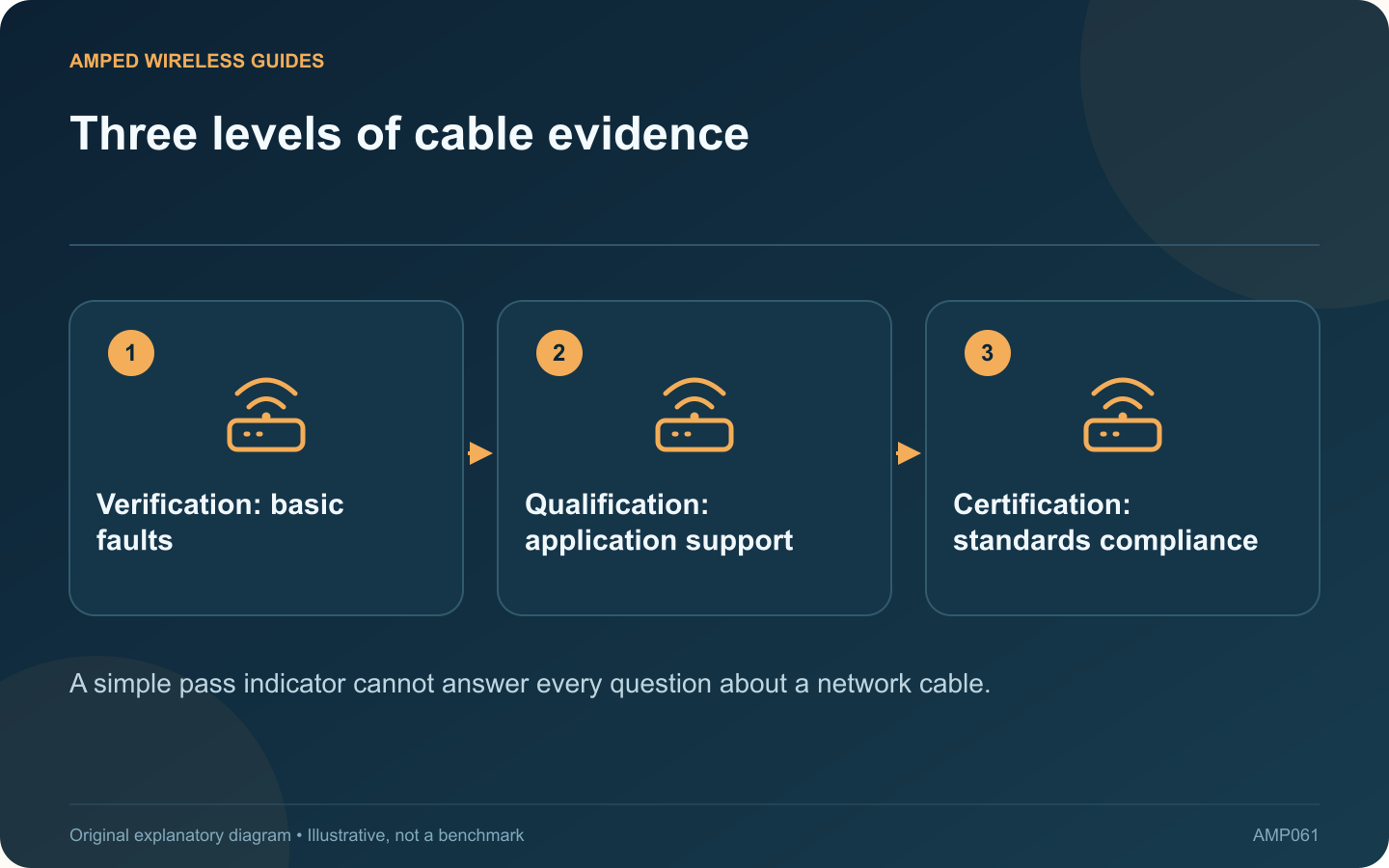
Three levels of cable evidence: Verification: basic faults; Qualification: application support; Certification: standards compliance
A simple pass indicator cannot answer every question about a network cable.

A basic tester can show that conductors connect from one end of an Ethernet cable to the other. That is useful, but it does not establish every performance characteristic needed for a fast or professionally specified installation.

Start with the question

Are you finding a broken patch lead, checking whether a link can support a target application, or accepting newly installed category-rated cabling? Those are different tasks. Fluke Networks distinguishes verification, qualification and certification to address them.

Use verification for basic faults

Depending on the tool, verification can identify wiring problems such as opens or incorrect connections. Read the tester’s actual capabilities. A row of lights should not be described as proof of high-frequency performance or compliance with a cabling category.

Use qualification for application suitability

A qualification tool evaluates support for particular network applications or rates. This can help investigate whether an existing link is suitable for the proposed upgrade without claiming that the installation has passed every standards parameter.

Use certification for specified acceptance

Certification measures compliance against the selected cabling standard and test configuration. If an installation contract or warranty requires it, request the appropriate saved reports rather than accepting an informal speed test as an equivalent substitute.

Make the result traceable

  • Record the cable or outlet identifier.
  • Identify the tool and selected test.
  • State whether patch cords were included.
  • Keep the original result and any failure details.

A technician should be able to match a report to the physical link later. Without that connection, even a detailed report may not resolve which wall outlet was tested.

For a home patch lead, a known-good replacement may be the quickest practical comparison. For permanent cabling, choose evidence appropriate to the installation’s value and requirements. The key is to describe what the test actually established, so a basic wiring pass is not mistaken for a guarantee of every future network speed.

Sources and editorial notes

Sources checked 8–9 October 2026. Independent guidance and original illustrations; product comparisons use published specifications rather than hands-on benchmarks. Check the exact model, revision and regional documentation before changing settings.

Related guides

300 FAQs across our guide libraries

Quick answers

100 practical questions from Amped Wireless Guides.

Browse all 100 FAQs
Does passing an Ethernet continuity test certify cable performance?

A basic tester can show that conductors connect from one end of an Ethernet cable to the other. That is useful, but it does not establish every performance characteristic needed for a fast or professionally specified installation. Are you finding a broken patch lead, checking whether a link can support a target application, or accepting newly installed category-rated cabling? Those are different tasks. Fluke Networks distinguishes verification, qualification and certification to address them.

Read the full guide and sources
How should I label and map wall Ethernet ports?

A wall outlet labelled only “computer” becomes confusing when the computer moves. A small, consistent cable-identification system makes network changes and fault finding much easier without requiring an elaborate management platform. Use identifiers tied to the installed link, such as a room code and outlet number. Keep the format short enough to read at both ends. Avoid putting passwords, private contact details or sensitive room information on publicly visible labels.

Read the full guide and sources
How does an Ethernet permanent link differ from a channel?

A structured cabling plan should distinguish the permanent link from the complete channel. The permanent link is the installed fixed cabling and its associated terminations; the channel also includes the equipment connections used to complete the path. Do not use the straight-line distance between rooms as the cable length. Include the actual route through permitted spaces, termination locations and appropriate service allowance. An installer should confirm the design before the cable is ordered.

Read the full guide and sources
What belongs in a fiber link plan for a detached building?

A detached office can benefit from a planned fiber connection when distance, electrical considerations or future capacity make an ordinary copper run unsuitable. The useful comparison includes the whole installation, not simply the price of a fiber patch cable. List the wired devices and wireless coverage required. The remote building normally needs suitable network equipment and its own power arrangement. Optical fiber does not deliver conventional Ethernet PoE to an access point at the other end.

Read the full guide and sources
Independent. Practical. Clear.

Amped Wireless Guides is an independent information website. We are not affiliated with or endorsed by Amped Wireless. Product names belong to their respective owners.