Independent extender & router guidesHelping you find your connection.
The guide library

Copper-clad aluminum Ethernet cable: why conductor material matters for PoE

Explore the guide library · Cabling and fiber

Inspect the cable specification instead of assuming a category label proves suitable conductors and power performance.
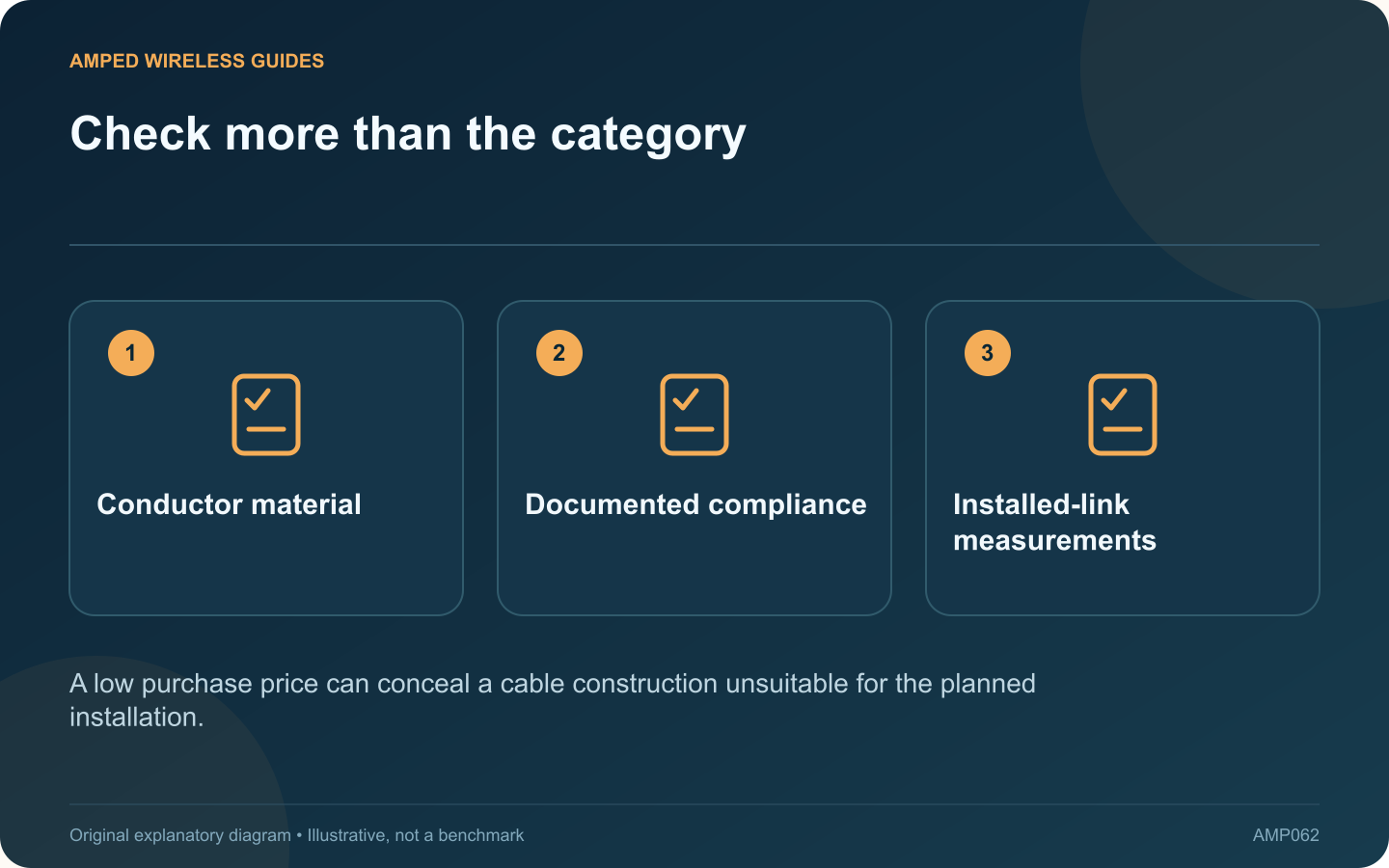
Check more than the category: Conductor material; Documented compliance; Installed-link measurements
A low purchase price can conceal a cable construction unsuitable for the planned installation.

When purchasing Ethernet cable, look for the conductor material as well as the category label. Copper-clad aluminum, commonly abbreviated CCA, is not the same construction as a suitable copper conductor. Fluke Networks highlights resistance and compliance concerns with CCA cabling.

Why power makes this relevant

PoE carries electrical power along the data cable. Resistance and balance affect that path as well as ordinary data performance. An installation that appears to pass light traffic does not thereby prove suitable behavior under the intended powered-device load.

Read the actual specification

Check the manufacturer, construction, conductor gauge, intended installation environment and compliance documentation. Avoid relying on an online title containing a category number. Retain purchase details so the installed material can be identified later.

Match the cable to the job

Permanent in-wall cabling, flexible patch leads and outdoor routes have different requirements. Appropriate fire and environmental ratings also matter. Ask a qualified installer to select and document the complete cabling system where building work is involved.

Use meaningful testing

  • A wire map can reveal certain connection faults.
  • Resistance-related measurements can reveal other problems.
  • Certification requires the appropriate tool and test limits.
  • PoE operation should be checked with the actual supported equipment.

Do not infer conductor quality from jacket color, connector appearance or one successful online speed test.

When questionable cable is already installed

Record its markings and the symptoms. Have the link assessed before increasing the PoE load or deploying higher-demand equipment. Replacing a short suspect patch lead is straightforward; permanent runs deserve a planned correction.

Do not open or modify powered electrical equipment to compensate for a cable problem. A reliable network starts with suitable materials and a documented installation. Checking conductor construction before purchase is usually much easier than diagnosing intermittent access-point or camera failures after the cable has been concealed.

Sources and editorial notes

Sources checked 8–9 October 2026. Independent guidance and original illustrations; product comparisons use published specifications rather than hands-on benchmarks. Check the exact model, revision and regional documentation before changing settings.

Related guides

300 FAQs across our guide libraries

Quick answers

100 practical questions from Amped Wireless Guides.

Browse all 100 FAQs
Why does copper-clad aluminum cable matter for PoE?

When purchasing Ethernet cable, look for the conductor material as well as the category label. Copper-clad aluminum, commonly abbreviated CCA, is not the same construction as a suitable copper conductor. Fluke Networks highlights resistance and compliance concerns with CCA cabling. PoE carries electrical power along the data cable. Resistance and balance affect that path as well as ordinary data performance. An installation that appears to pass light traffic does not thereby prove suitable behavior under the intended powered-device load.

Read the full guide and sources
What belongs in a fiber link plan for a detached building?

A detached office can benefit from a planned fiber connection when distance, electrical considerations or future capacity make an ordinary copper run unsuitable. The useful comparison includes the whole installation, not simply the price of a fiber patch cable. List the wired devices and wireless coverage required. The remote building normally needs suitable network equipment and its own power arrangement. Optical fiber does not deliver conventional Ethernet PoE to an access point at the other end.

Read the full guide and sources
When should Ethernet cable use solid or stranded conductors?

Solid and stranded Ethernet conductors serve different installation needs. Fixed building cabling and a flexible lead moved around a desk are not necessarily best made from the same construction. Fluke Networks explains why conductor design affects flexibility and electrical behavior. A permanent run is normally installed once and terminated as part of a structured system. An equipment patch cord may bend and move repeatedly. Buy a cable intended for that role rather than choosing solely by jacket color or category number.

Read the full guide and sources
Does passing an Ethernet continuity test certify cable performance?

A basic tester can show that conductors connect from one end of an Ethernet cable to the other. That is useful, but it does not establish every performance characteristic needed for a fast or professionally specified installation. Are you finding a broken patch lead, checking whether a link can support a target application, or accepting newly installed category-rated cabling? Those are different tasks. Fluke Networks distinguishes verification, qualification and certification to address them.

Read the full guide and sources
Independent. Practical. Clear.

Amped Wireless Guides is an independent information website. We are not affiliated with or endorsed by Amped Wireless. Product names belong to their respective owners.