Explore the guide library · Outdoor coverage and bridges
Use the complete manufacturer-approved mounting, sealing and power arrangement for outdoor equipment.
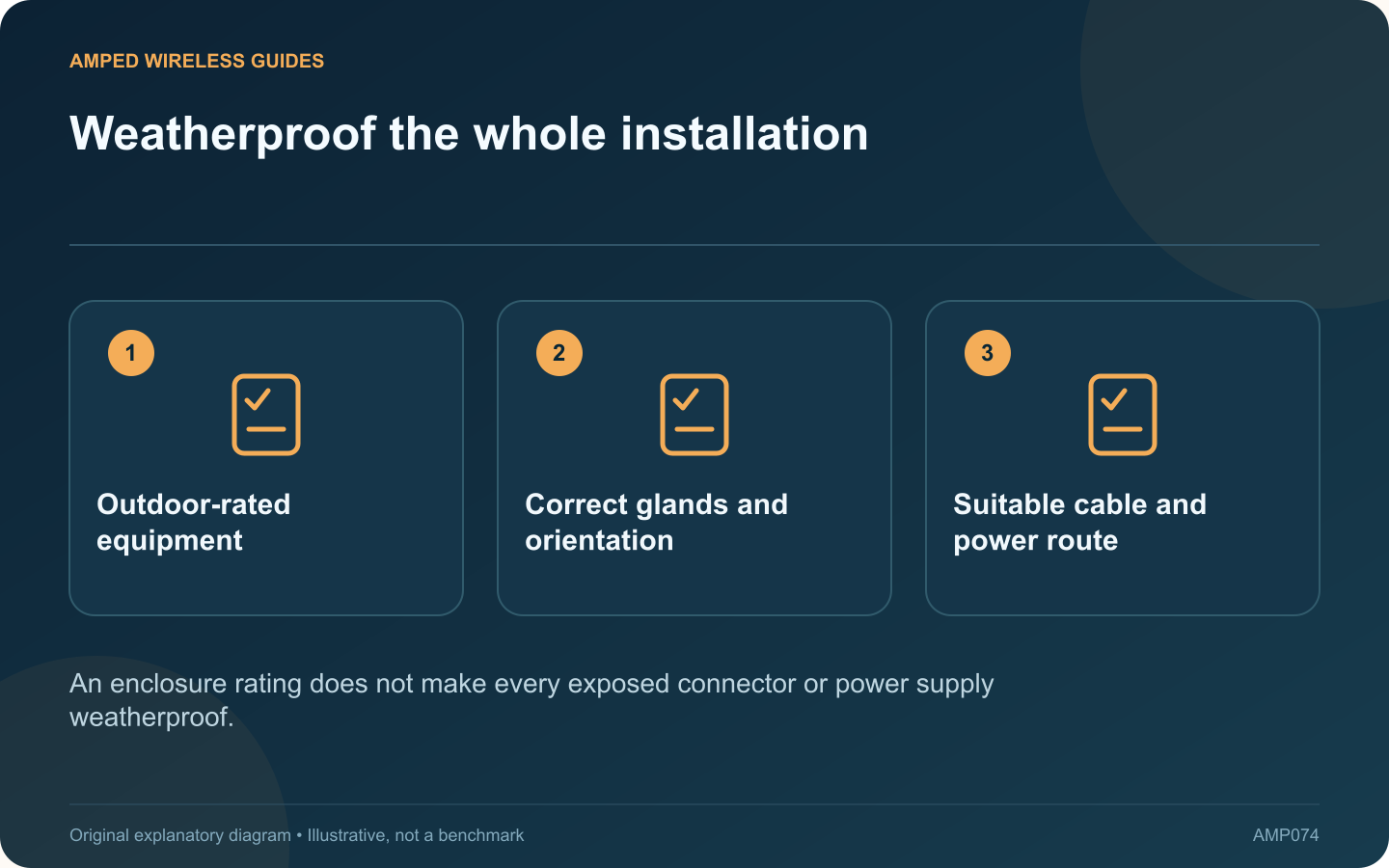
An outdoor-rated access point still needs a correctly installed cable entry, mounting arrangement and power connection. The enclosure’s rating should not be interpreted as permission to leave arbitrary connectors or an indoor power supply exposed to weather.
Read the complete installation guide
For example, TP-Link’s Deco X50-Outdoor guidance distinguishes supported power arrangements and installation details. Use the instructions for the exact product and regional version rather than borrowing a sealing method from another outdoor device.
Plan every exposed component
Identify where the cable enters the building, where power originates and which connectors remain outside. Cable jacket suitability, mounting orientation and the supplied weatherproof accessories all form part of the installation.
Preserve the specified seals
Fit glands, covers and other supplied components as directed. A cable of the wrong diameter or a missing sealing part can compromise the intended protection. Do not improvise a permanent solution solely with household tape or an unapproved enclosure.
Choose safe maintenance access
- Mount where inspection is practical.
- Keep cables protected from accidental pulling.
- Use appropriate professional help for height or electrical work.
- Follow the required grounding and surge-protection design.
Test after installation
Confirm the negotiated wired link, supported power state and coverage in the intended area. Keep photographs of the completed arrangement and the product’s installation documentation for future maintenance.
Inspect according to the manufacturer’s recommendations and after relevant environmental damage, without opening energized equipment or working at height unsafely. If water ingress or damaged wiring is suspected, arrange proper service rather than repeatedly restarting the network.
A reliable outdoor connection depends on the whole assembly remaining suitable for its environment. Selecting the correct access point is only the first step; preserving its intended protection at the cable and power interfaces is what allows that equipment to remain useful outside.
Sources and editorial notes
Sources checked 8–9 October 2026. Independent guidance and original illustrations; product comparisons use published specifications rather than hands-on benchmarks. Check the exact model, revision and regional documentation before changing settings.
- TP-Link: Deco X50-Outdoor specifications
- TP-Link: Deco X50-Outdoor installation and power requirements
- Cisco: physical infrastructure, fiber and cable installation