Independent extender & router guidesHelping you find your connection.
The guide library

Wireless bridge planning: seeing the other building is not the whole path check

Explore the guide library · Outdoor coverage and bridges

Account for clearance around the direct line, seasonal foliage and stable mounting positions.
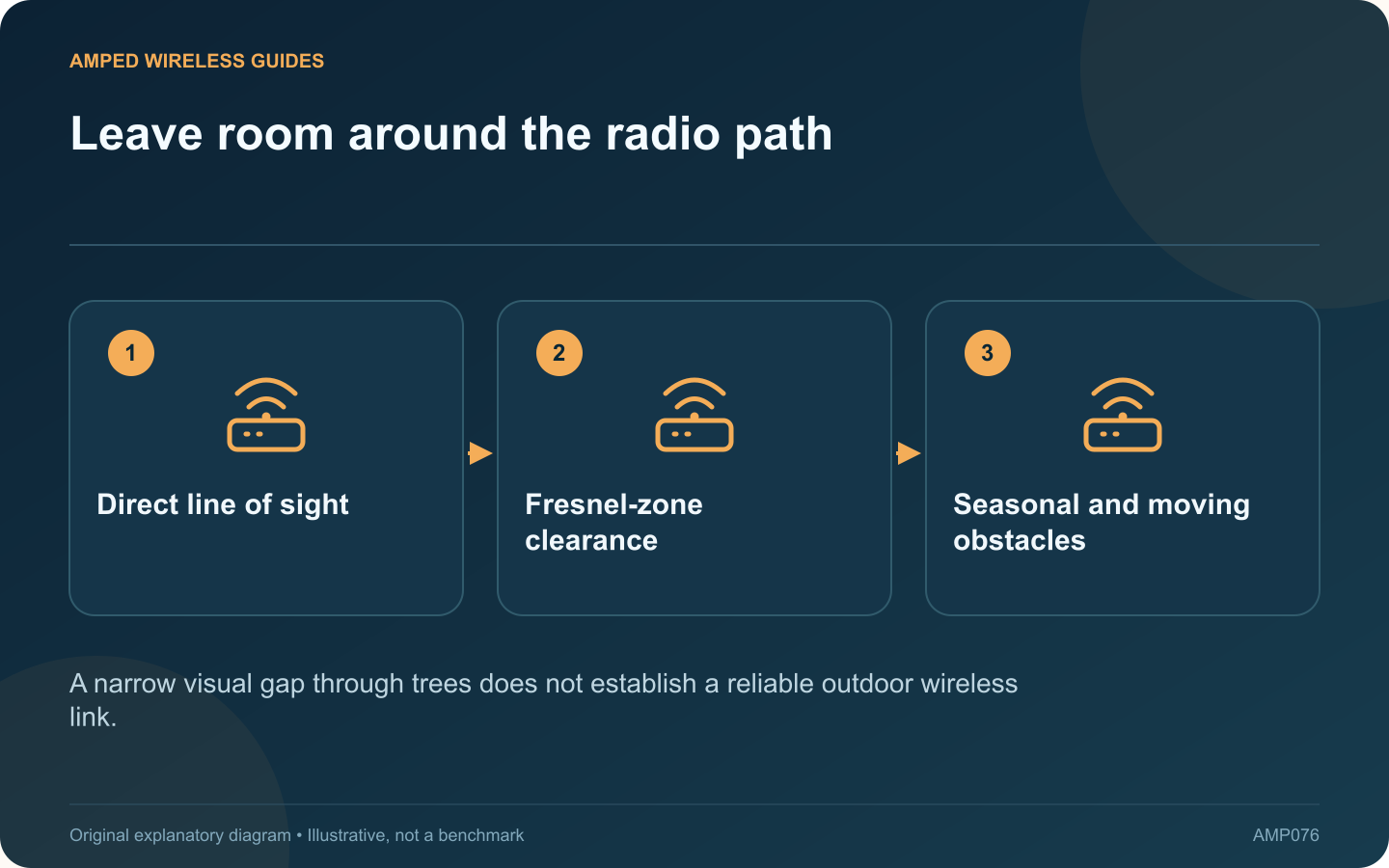
Leave room around the radio path: Direct line of sight; Fresnel-zone clearance; Seasonal and moving obstacles
A narrow visual gap through trees does not establish a reliable outdoor wireless link.

A clear view between two wireless bridge endpoints is a useful starting point, but it is not a complete path assessment. Radio propagation also depends on clearance around the direct line, commonly considered through the Fresnel zone.

Understand the practical implication

Ubiquiti’s wireless training guidance explains line of sight and Fresnel clearance. For a property owner, the important point is that a tiny visible gap between branches may still be unsuitable for a reliable link.

Inspect the route over time

Consider leaves, growing vegetation, parked vehicles and moving objects. A winter installation can behave differently when trees fill out. Record obstacles along the route rather than checking only what is immediately beside each radio.

Use a proper link plan

The necessary clearance depends on the link’s frequency and geometry. Have a competent installer assess mounting height, legal radio settings and supported equipment. Do not use a single generic clearance number for every distance and product.

Check mounting stability

  • The support should remain secure in expected weather.
  • Alignment should not change with ordinary movement.
  • Cable entry and power must suit outdoor use.
  • Maintenance should be possible without unsafe access.

Validate beyond a link light

Measure sustained traffic in both directions and observe the connection during representative conditions. A brief successful association does not demonstrate the stability needed for work calls or remote equipment.

Keep the installer’s alignment and signal records so later changes can be compared. If deterioration follows foliage growth or a new obstruction, that evidence can direct the next inspection.

Do not improvise unsafe roof work or alter trees without the relevant authorization. If a suitable radio path cannot be established, compare a professionally installed cable route or another location. A reliable bridge starts with a realistic path design, not a promise that enough transmit power will overcome every obstruction.

Sources and editorial notes

Sources checked 8–9 October 2026. Independent guidance and original illustrations; product comparisons use published specifications rather than hands-on benchmarks. Check the exact model, revision and regional documentation before changing settings.

Related guides

300 FAQs across our guide libraries

Quick answers

100 practical questions from Amped Wireless Guides.

Browse all 100 FAQs
Is seeing the far building enough to plan a wireless bridge?

A clear view between two wireless bridge endpoints is a useful starting point, but it is not a complete path assessment. Radio propagation also depends on clearance around the direct line, commonly considered through the Fresnel zone. Ubiquiti's wireless training guidance explains line of sight and Fresnel clearance. For a property owner, the important point is that a tiny visible gap between branches may still be unsuitable for a reliable link.

Read the full guide and sources
Do a garden access point and a building bridge do the same job?

An outdoor access point and a point-to-point bridge may both look like ways to extend a network outside, but they solve different problems. Decide whether you need service for roaming client devices or a fixed link to another building. An appropriately installed outdoor access point can provide client coverage in the intended area. It needs a suitable upstream connection and power arrangement. Plan its position around where people will use devices, not simply where mounting is easiest.

Read the full guide and sources
Could DFS events explain outdoor bridge disconnections?

An outdoor wireless link that disconnects and later reconnects may be reacting to a channel event rather than losing power. If the equipment uses a DFS channel, radar detection can require a change in operation under the applicable radio rules. Record when the interruption occurs and whether both endpoints remain powered. Compare device uptime and available event logs. A restart, a lost Ethernet link and a radio channel change are different events that can produce a similar user-visible outage.

Read the full guide and sources
Why can a building bridge connect without providing indoor Wi-Fi?

A building bridge can successfully carry Ethernet traffic to a workshop while providing no suitable everyday Wi-Fi service for phones inside. That can be an incomplete design rather than a defective bridge. TP-Link's AP-plus-client CPE topology illustrates a link between fixed endpoints. Read the actual product's operating modes. A directional radio's management or bridge network should not automatically be treated as the workshop's general client access point.

Read the full guide and sources
Independent. Practical. Clear.

Amped Wireless Guides is an independent information website. We are not affiliated with or endorsed by Amped Wireless. Product names belong to their respective owners.