Independent extender & router guidesHelping you find your connection.
The guide library

Camera traffic rises when the scene gets busy: plan for more than idle bitrate

Explore the guide library · Device coverage projects

Motion and encoding settings can change video traffic, so test the network during representative camera activity.
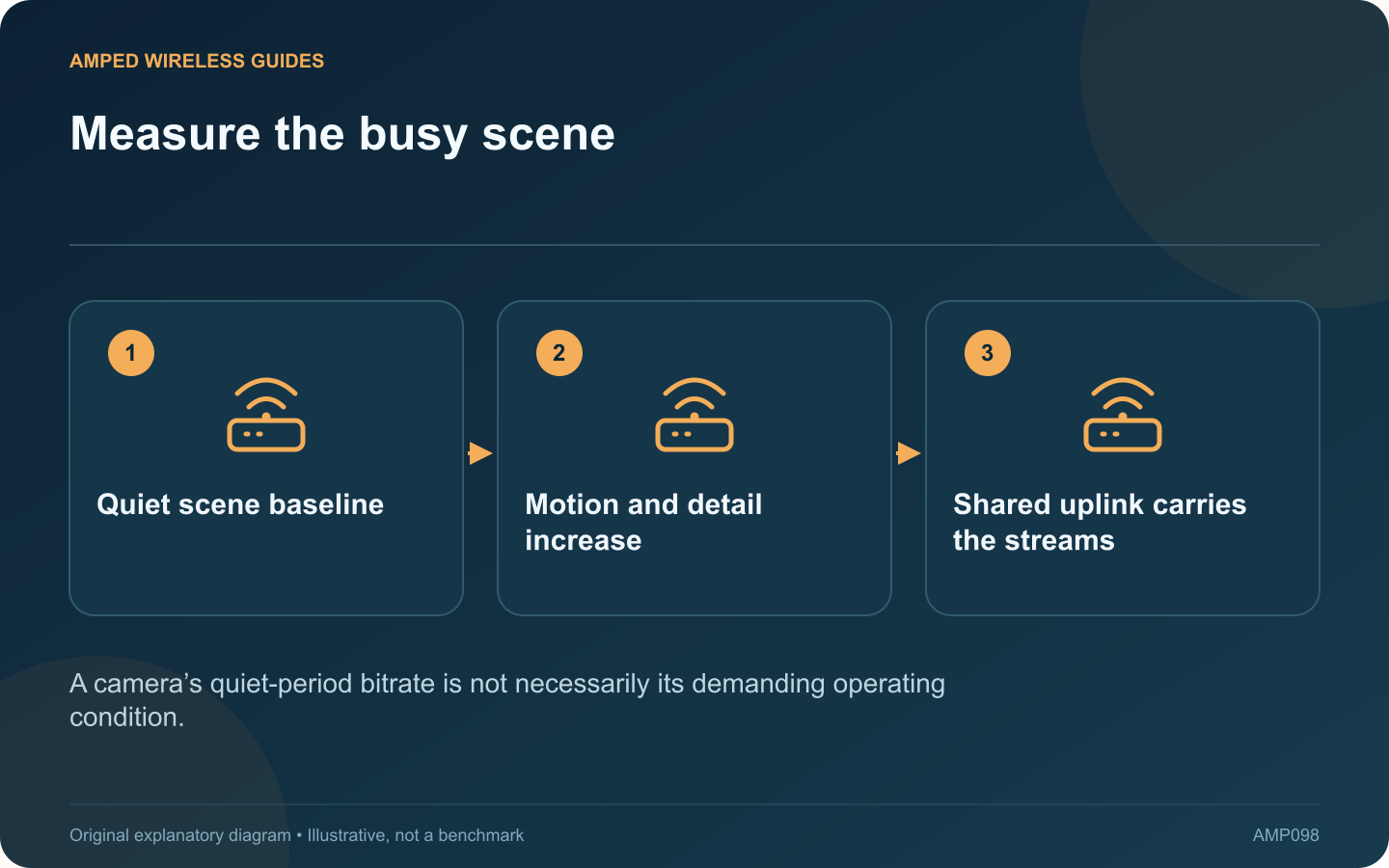
Measure the busy scene: Quiet scene baseline; Motion and detail increase; Shared uplink carries the streams
A camera’s quiet-period bitrate is not necessarily its demanding operating condition.

A camera network can appear comfortable while scenes are quiet and become congested when several views grow active. Video bitrate can vary with scene detail, motion and encoding settings, so an idle observation is not a complete capacity plan.

Read the camera’s bitrate mode

Axis explains variable, maximum and average bitrate approaches. The available controls depend on the camera. Understand what the selected mode prioritizes before changing a limit, since constraining traffic can affect image quality or other recording characteristics.

Map where streams travel

Determine whether footage goes to a local recorder, cloud service or both. A local recording stream and a cloud upload can stress different links. Remote viewing may add another stream rather than simply reusing the one you measured earlier.

Observe representative activity

  • Several cameras active together.
  • Normal motion and changing lighting.
  • Recording and live viewing at the same time.
  • Other household uploads or calls.

Use scenes and devices you are authorized to monitor. Keep recorded footage and diagnostic information private.

Separate power from data symptoms

A PoE camera’s power consumption can also vary by operating state. If a camera restarts, inspect power and device uptime rather than assuming that every interruption is a bandwidth problem. If it remains online but video degrades, inspect the stream and network path.

Choose the targeted improvement

Possible actions include a suitable wired connection, sufficient switch uplink capacity or supported encoding settings that preserve the required evidence quality. Do not reduce recording quality blindly just to make a speed graph look quiet.

Retest the busy scenario after changes and keep the chosen settings documented. A useful camera-network plan supports the moments when something happens, not only the periods when every scene is still. Measuring those conditions gives a sounder basis for equipment and bandwidth decisions.

Sources and editorial notes

Sources checked 8–9 October 2026. Independent guidance and original illustrations; product comparisons use published specifications rather than hands-on benchmarks. Check the exact model, revision and regional documentation before changing settings.

Related guides

300 FAQs across our guide libraries

Quick answers

100 practical questions from Amped Wireless Guides.

Browse all 100 FAQs
Why can camera network traffic rise when a scene becomes busy?

A camera network can appear comfortable while scenes are quiet and become congested when several views grow active. Video bitrate can vary with scene detail, motion and encoding settings, so an idle observation is not a complete capacity plan. Axis explains variable, maximum and average bitrate approaches. The available controls depend on the camera. Understand what the selected mode prioritizes before changing a limit, since constraining traffic can affect image quality or other recording characteristics.

Read the full guide and sources
What local network path matters for wireless PC VR?

Wireless PC VR sends a demanding interactive stream between the computer and headset. When that local path is unreliable, buying a faster internet subscription may not address the cause. Start by drawing how the PC and headset actually reach each other. Steam publishes supported headset and network requirements for Steam Link. Confirm the exact headset, computer software and wireless capabilities before purchasing equipment. Requirements can change, so use the current official page rather than an old retailer description.

Read the full guide and sources
Where should I test a doorbell’s Wi-Fi connection?

A phone can browse comfortably near the front door while a fixed doorbell has an unreliable connection. The devices may use different radios, positions and bands, and opening the door for a test can change the signal path. Ring's guidance describes connection health through RSSI and model-specific Wi-Fi recommendations. Use the app's information for the actual device. Do not apply one internet forum's signal threshold as a universal rule for every doorbell.

Read the full guide and sources
How do I choose the next networking device for a particular room?

The best networking purchase depends on what is missing in a particular room. A switch adds wired connections, an access point supplies wireless service, and an extender or bridge changes how that service reaches the location. Start with the job before choosing a product. These are specification-based examples, not a universal ranking or hands-on award list. Verify local versions, required power, controller support and compatibility with the existing router. Include every endpoint and accessory needed to make the proposed path work.

Read the full guide and sources
Independent. Practical. Clear.

Amped Wireless Guides is an independent information website. We are not affiliated with or endorsed by Amped Wireless. Product names belong to their respective owners.