Independent extender & router guidesHelping you find your connection.
The guide library

Doorbell Wi-Fi problems: test the connection at the closed front door

Explore the guide library · Device coverage projects

Use the doorbell’s own connection health and a realistic placement test before adding an extender.
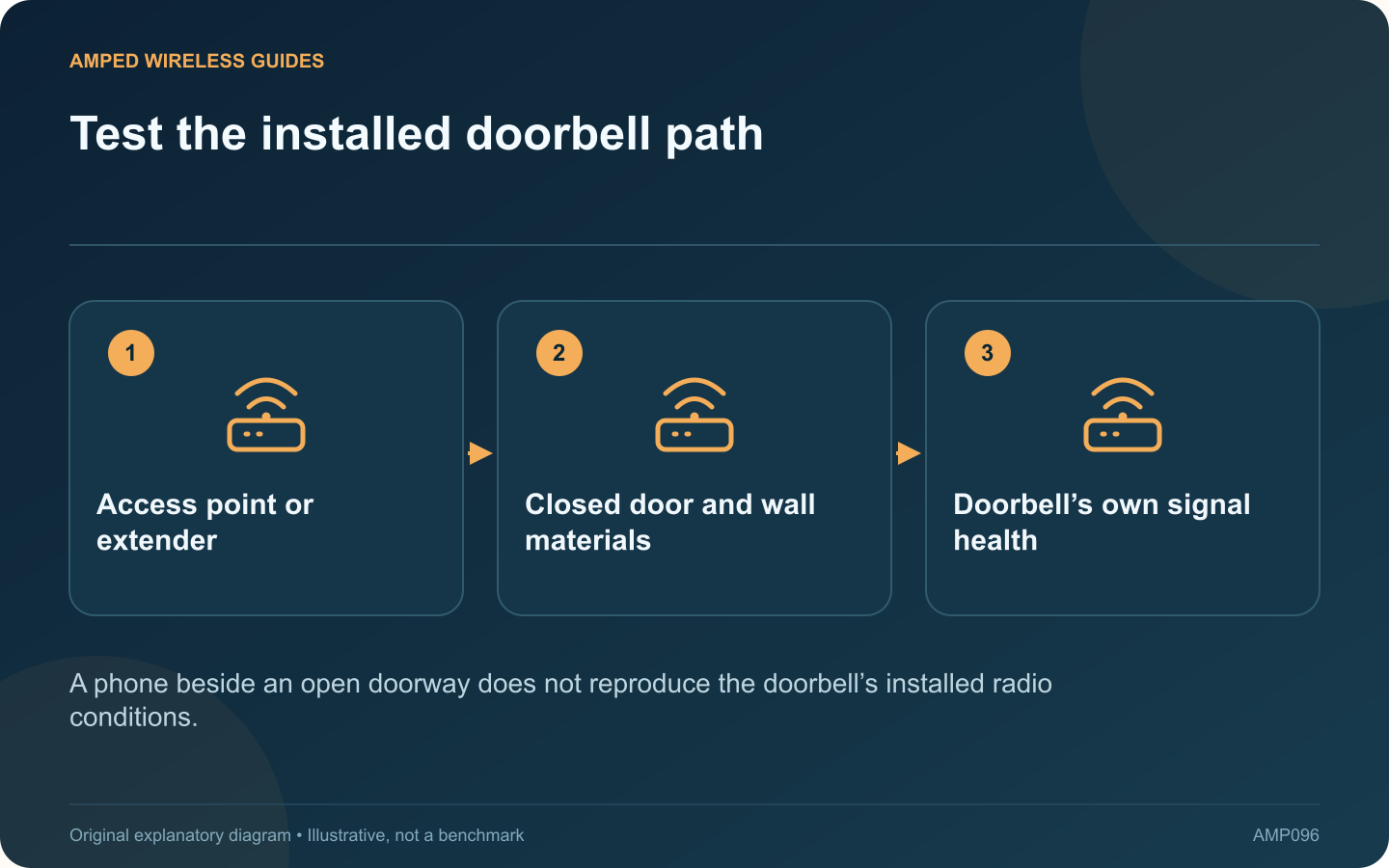
Test the installed doorbell path: Access point or extender; Closed door and wall materials; Doorbell’s own signal health
A phone beside an open doorway does not reproduce the doorbell’s installed radio conditions.

A phone can browse comfortably near the front door while a fixed doorbell has an unreliable connection. The devices may use different radios, positions and bands, and opening the door for a test can change the signal path.

Read the doorbell’s own status

Ring’s guidance describes connection health through RSSI and model-specific Wi-Fi recommendations. Use the app’s information for the actual device. Do not apply one internet forum’s signal threshold as a universal rule for every doorbell.

Test normal physical conditions

Keep the door closed, the device mounted and nearby objects in their usual positions. Observe live-view startup, notifications and the function that is failing. Repeat at different ordinary times rather than relying only on a nearby phone’s speed test.

Check the upstream path

If an extender serves the doorbell, verify its connection back to the router. Placing it immediately beside the doorbell can be ineffective if that location also receives a weak upstream signal. A supported wired access point may offer another option.

Confirm model compatibility

  • Supported frequency bands.
  • Required wireless security mode.
  • Power and battery condition.
  • Current firmware and app guidance.

A wireless symptom can coexist with a power or application issue, so preserve the device-health evidence before resetting it.

Choose suitable hardware placement

Indoor extenders should remain in their intended environment. If outdoor equipment is needed, include weatherproof installation and a compatible power route. Do not expose an indoor plug-in unit to rain to move it a little closer.

After any change, repeat the same doorbell actions with the door closed. Keep the result that improves the actual service, not merely another device’s signal bars. The goal is a reliable connection for the installed doorbell under the conditions in which it must detect and communicate real visits.

Sources and editorial notes

Sources checked 8–9 October 2026. Independent guidance and original illustrations; product comparisons use published specifications rather than hands-on benchmarks. Check the exact model, revision and regional documentation before changing settings.

Related guides

300 FAQs across our guide libraries

Quick answers

100 practical questions from Amped Wireless Guides.

Browse all 100 FAQs
Where should I test a doorbell’s Wi-Fi connection?

A phone can browse comfortably near the front door while a fixed doorbell has an unreliable connection. The devices may use different radios, positions and bands, and opening the door for a test can change the signal path. Ring's guidance describes connection health through RSSI and model-specific Wi-Fi recommendations. Use the app's information for the actual device. Do not apply one internet forum's signal threshold as a universal rule for every doorbell.

Read the full guide and sources
How do I choose the next networking device for a particular room?

The best networking purchase depends on what is missing in a particular room. A switch adds wired connections, an access point supplies wireless service, and an extender or bridge changes how that service reaches the location. Start with the job before choosing a product. These are specification-based examples, not a universal ranking or hands-on award list. Verify local versions, required power, controller support and compatibility with the existing router. Include every endpoint and accessory needed to make the proposed path work.

Read the full guide and sources
What local network path matters for wireless PC VR?

Wireless PC VR sends a demanding interactive stream between the computer and headset. When that local path is unreliable, buying a faster internet subscription may not address the cause. Start by drawing how the PC and headset actually reach each other. Steam publishes supported headset and network requirements for Steam Link. Confirm the exact headset, computer software and wireless capabilities before purchasing equipment. Requirements can change, so use the current official page rather than an old retailer description.

Read the full guide and sources
Why can camera network traffic rise when a scene becomes busy?

A camera network can appear comfortable while scenes are quiet and become congested when several views grow active. Video bitrate can vary with scene detail, motion and encoding settings, so an idle observation is not a complete capacity plan. Axis explains variable, maximum and average bitrate approaches. The available controls depend on the camera. Understand what the selected mode prioritizes before changing a limit, since constraining traffic can affect image quality or other recording characteristics.

Read the full guide and sources
Independent. Practical. Clear.

Amped Wireless Guides is an independent information website. We are not affiliated with or endorsed by Amped Wireless. Product names belong to their respective owners.