Independent extender & router guidesHelping you find your connection.
The guide library

Wi-Fi Clone on a powerline extender does not create the powerline link

Explore the guide library · Powerline networking

Treat wireless names, powerline pairing and mesh compatibility as three separate setup checks.
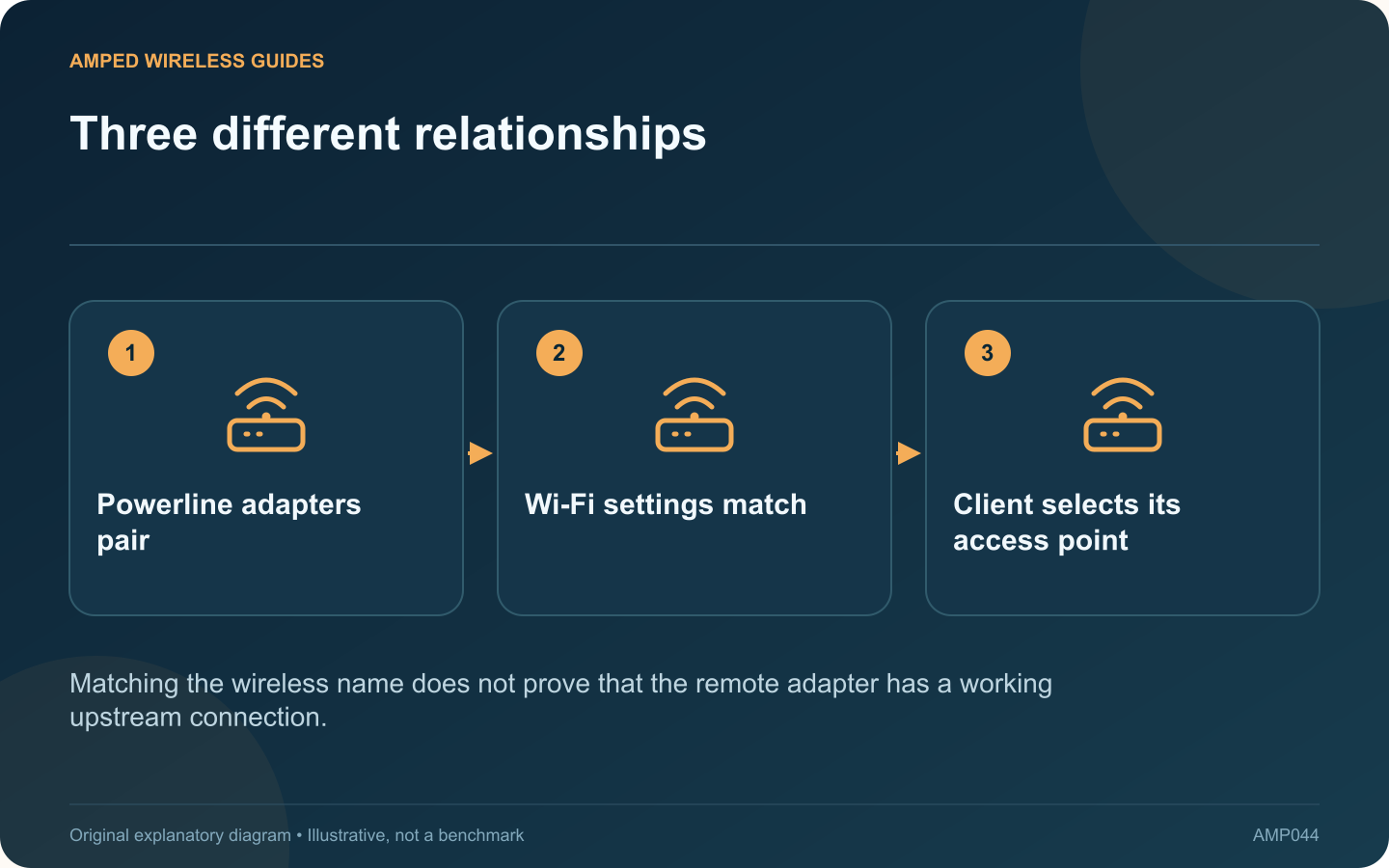
Three different relationships: Powerline adapters pair; Wi-Fi settings match; Client selects its access point
Matching the wireless name does not prove that the remote adapter has a working upstream connection.

A Wi-Fi powerline extender performs two jobs: it reaches the router through a supported powerline connection and provides a wireless connection for nearby devices. Copying the router’s wireless settings addresses the second job, not the first.

Verify the upstream connection first

Follow the kit’s pairing procedure and check its powerline status. If the remote unit has an Ethernet port, a wired client can help test this path without adding wireless behavior to the investigation. Use a device you control and restore its normal connection afterward.

Copy settings through the documented feature

Models and revisions differ in how they copy or synchronize an SSID and password. Consult the exact manual for its button sequence or app controls. A general setup video for another product may describe different timing or capabilities.

Distinguish matching names from mesh

Two access points using the same network name do not automatically become a coordinated mesh system. TP-Link’s mesh-family guidance makes compatibility a product-specific question. Check the required router, extender firmware and supported ecosystem before relying on mesh behavior.

Check what the client actually does

Client devices participate in roaming decisions. A phone may remain connected to the original router even beside the powerline extender. Inspect the connected access point where your device or management interface exposes that information.

Test each layer separately

Observation Relevant layer
Remote wired client has no access Powerline or upstream path
Wrong wireless password SSID security configuration
Phone stays on distant access point Client roaming and system support

Keep a record of the final network names and approved security settings without publishing passwords. Once the wired upstream path works, test the wireless connection in the intended room and while walking between coverage areas. This order prevents a wireless cloning operation from masking an unresolved powerline pairing problem.

Sources and editorial notes

Sources checked 8–9 October 2026. Independent guidance and original illustrations; product comparisons use published specifications rather than hands-on benchmarks. Check the exact model, revision and regional documentation before changing settings.

Related guides

300 FAQs across our guide libraries

Quick answers

100 practical questions from Amped Wireless Guides.

Browse all 100 FAQs
Does Wi-Fi Clone establish a powerline link?

A Wi-Fi powerline extender performs two jobs: it reaches the router through a supported powerline connection and provides a wireless connection for nearby devices. Copying the router's wireless settings addresses the second job, not the first. Follow the kit's pairing procedure and check its powerline status. If the remote unit has an Ethernet port, a wired client can help test this path without adding wireless behavior to the investigation. Use a device you control and restore its normal connection afterward.

Read the full guide and sources
What compatibility difference matters between PG2400P and TL-PA9020P?

The PG2400P and TL-PA9020P are both intended to extend wired networking through suitable mains wiring, but they belong to different powerline families. TP-Link identifies the former as G.hn and the latter as HomePlug AV2. That difference should lead the purchase decision. List the adapters already serving other rooms. A matching supported family may simplify expansion. Replacing just one endpoint with a different standard will not create a faster mixed pair; it can leave that endpoint unable to communicate at all.

Read the full guide and sources
When does Deco PX50’s integrated powerline backhaul help?

Deco PX50 is worth investigating when thick walls make wireless backhaul difficult and Ethernet cannot conveniently reach the next node. Its integrated powerline capability is the main distinction to evaluate against an ordinary X50 deployment, rather than assuming a similar model name means identical connection options. TP-Link's current PLC FAQ says the main Deco must support powerline backhaul. It also specifies compatible powerline families. Plan the main unit and satellites together; adding a single PX50 to an arbitrary existing layout is not sufficient proof that PLC backhaul will operate.

Read the full guide and sources
Why might a powerline adapter blink after a computer sleeps?

A change in a powerline adapter's lights after the attached computer sleeps does not necessarily mean the network has failed. Some models enter a power-saving state when their Ethernet client is inactive. The important test is what happens when normal activity resumes. For example, TP-Link describes power-saving behavior for the TL-PA8010P revision covered by its guide, including an idle period and a slowly blinking indicator. Other products may use different timing and light patterns. Identify the hardware revision before interpreting them.

Read the full guide and sources
Independent. Practical. Clear.

Amped Wireless Guides is an independent information website. We are not affiliated with or endorsed by Amped Wireless. Product names belong to their respective owners.